# How do smart contracts communicate?
> Smart contracts use their ABI to define functions, encode contract calls for the EVM, and read data from transactions.
> For the complete documentation index, see [llms.txt](/docs/llms.txt).
**Previous Section Recap**
In the previous section, we looked at functions and their various forms of visibility, which dictates who can actually call into a function:
* **public** = anyone can call this function
* **external** = anyone, outside of this contract, can call this function
* **internal** = only this contract and its inheritance chain can call this function
* **private** = only this contract can call this function
We also looked at how "getter" function can be declared as either `view` or `pure`:
* **view** = declares that no state will be changed
* **pure** = declares that no state variable will be changed *or* read
Pop Quiz: What is the default visibility for state variables?
## Smart Contract Compilation
Up until now, we've learned about the Solidity programming language and how it used to write programs on the [Ethereum computer](/docs/what-is-ethereum), otherwise referred to as **smart contracts**.
Let's get a little lower-level... In order to understand how contracts communicate, we must first understand:
1. contract **compilation**
2. contract **deployment**
3. contract **interaction**
### Contract Compilation Produces Two Artifacts: ABI & Bytecode
When a smart contract is compiled, the Solidity compilation process produces two *very important artifacts*:

1. [the contract's **ABI**](https://docs.soliditylang.org/en/v0.8.13/abi-spec.html):
* we *keep* the ABI for front-end libraries to be able to communicate with the contract
2. the contract's **bytecode**
* we *deploy* the bytecode directly to the blockchain, in which case it is stored directly in the contract account's state trie
### ABI - Application Binary Interface (Computer Science)
In computer science, an ABI is typically an interface between two program modules. For example, an operating system must communicate with a user program somehow. That communication is bridged by an **ABI**, an **Application Binary Interface**.
An ABI defines how data structures and functions are accessed in the machine code. Thus, this is the primary way of encoding/decoding data in and out of machine code.
You can think of an ABI as a general encoding/decoding bridge for machine code. 🤖
### ABI - Application Binary Interface (Ethereum)
**In Ethereum, a contract's ABI is [the standard way to interact with a contract](/docs/smart-contract-abi).**
The ABI is needed to communicate with smart contracts, whether you are:
* attempting to interact with a contract from outside the blockchain (ie. interacting with a smart contract via a dApp)
* attempting a contract-to-contract interaction (ie. a contract performing a JUMP call to another contract), t
The ABI is used to encode contract calls for the EVM and to read data out of transactions.
In Ethereum, the purpose of the ABI is to:
1. **define the functions in the contract that can be invoked** and...
2. **describe how each function will accept arguments and return its result**
### What Does the ABI Look Like? 🤔
Let's look at a quick Solidity smart contract:
```solidity solidity
// SPDX-Licence-Identifier: MIT
pragma solidity 0.8.4;
contract Counter {
uint public count;
// Function to get the current count
function get() public view returns (uint) {
return count;
}
// Function to increment count by 1
function inc() public {
count += 1;
}
// Function to decrement count by 1
function dec() public {
// This function will fail if count = 0
count -= 1;
}
}
```
`Counter.sol` is a simple smart contract that presides over one single state variable: `count`. There are a few function that directly control the `count` state and anyone can call them. That's all fine as well, but what if we want to cool a function from this contract from a front-end library like Ethers.js? This is where you'll need the ABI!
This is what the `Counter.sol` ABI looks like:
```json json
[
{
"inputs": [],
"name": "count",
"outputs": [
{
"internalType": "uint256",
"name": "",
"type": "uint256"
}
],
"stateMutability": "view",
"type": "function"
},
{
"inputs": [],
"name": "dec",
"outputs": [],
"stateMutability": "nonpayable",
"type": "function"
},
{
"inputs": [],
"name": "get",
"outputs": [
{
"internalType": "uint256",
"name": "",
"type": "uint256"
}
],
"stateMutability": "view",
"type": "function"
},
{
"inputs": [],
"name": "inc",
"outputs": [],
"stateMutability": "nonpayable",
"type": "function"
}
]
```
As you can see, the ABI of a contract is just one big JSON object. As developers, we simply need to know that the ABI is necessary in order for front-end tools to be able to interface and thus communicate with a smart contract! 💻🗣📜 This is further explained in the **ABI Encoding** section below.
If you aren't familiar with the term "calldata", make sure to review the last
section of [Intro to
Transactions](https://university.alchemy.com/course/ethereum/md/intro-to-ethereum-transactions).
🧠
### ABI vs API
Similar to an API, the ABI is a human-readable representation of a code's interface. An ABI defines the methods and structures used to interact with the machine code representation of a contract, just like APIs do for higher-level composability.
### ABI Encoding
The ABI indicates to the caller of a contract function *how* to encode the needed information, such as function signatures and variable declarations, in such a way that the EVM knows how to communicate that call to the deployed contract's bytecode.
### Interacting With a Smart Contract
If your web application wants to interact with a smart contract on Ethereum, it needs:
1. the contract's **address**
2. the contract's **ABI**
We provide the ABI to the front-end library. The front-end library then translates and delivers any requests we make using that ABI.
Let's look at an example...
#### Ethers.js Contract Instance Example
[`Contract` is a class abstraction in ethers.js](https://docs.ethers.org/v5/api/contract/contract/) that allows us to create programmatic instances of contracts in a flash.
Here is a quick script that can be used to interact with the `Counter.sol` contract we inspected above, [now deployed on Göerli test network](https://sepolia.etherscan.io/address/0x5F91eCd82b662D645b15Fd7D2e20E5e5701CCB7A):
```javascript javascript
require('dotenv').config();
const ethers = require('ethers');
const contractABI = [
{
inputs: [],
name: 'count',
outputs: [{ internalType: 'uint256', name: '', type: 'uint256' }],
stateMutability: 'view',
type: 'function',
},
{
inputs: [],
name: 'dec',
outputs: [],
stateMutability: 'nonpayable',
type: 'function',
},
{
inputs: [],
name: 'get',
outputs: [{ internalType: 'uint256', name: '', type: 'uint256' }],
stateMutability: 'view',
type: 'function',
},
{
inputs: [],
name: 'inc',
outputs: [],
stateMutability: 'nonpayable',
type: 'function',
},
];
const provider = new ethers.providers.AlchemyProvider(
'goerli',
process.env.TESTNET_ALCHEMY_KEY
);
const wallet = new ethers.Wallet(process.env.TESTNET_PRIVATE_KEY, provider);
async function main() {
const counterContract = new ethers.Contract(
'0x5F91eCd82b662D645b15Fd7D2e20E5e5701CCB7A',
contractABI,
wallet
);
await counterContract.inc();
}
main();
```
Here is a full video of the process, if you want to code along with us!
## Bytecode
We've covered the main artifact produced via contract compilation: the contract's ABI. Now let's look at what is produced at contract deployment: the contract's bytecode. Contract bytecode is the translation of that smart contract that [machines can understand](/docs/how-does-solidity-work), specifically the EVM. It represents the actual program, in machine code, on the Ethereum computer.
There are two types of bytecode:
1. **Creation time bytecode** - is executed only once at deployment, contains the `constructor`
2. **Run time bytecode** - is stored on the blockchain as permanent executable
## Transaction Receipt
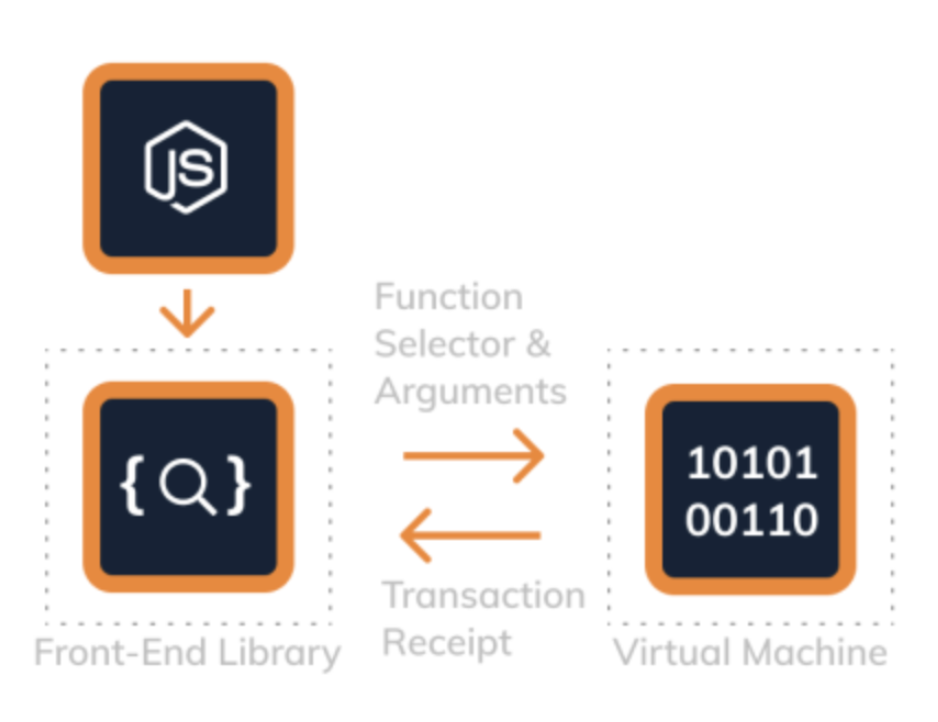
As in the script above, we provide the ABI to ethers. Once ethers has the contract's ABI, we can make a call to the [`Counter`](https://sepolia.etherscan.io/address/0x5F91eCd82b662D645b15Fd7D2e20E5e5701CCB7A#code) smart contract's `inc()` function. Like the image above shows, the front-end library then translates and delivers any requests using the ABI. Once the transaction is successfully sent and validated on the Ethereum network, a **receipt** is generated containing logs and any gas used.
### Receipts Trie
Anytime a transaction occurs on the Ethereum network, the receipt is stored in the [receipt trie of that block](/docs/patricia-merkle-tries). The trie contains four pieces of information:
* Post-Transaction State
* Cumulative Gas Used
* Set of Logs Created During Execution (ie. did any **events** fire?)
* Bloom Filter Composed from the Logs
## Conclusion
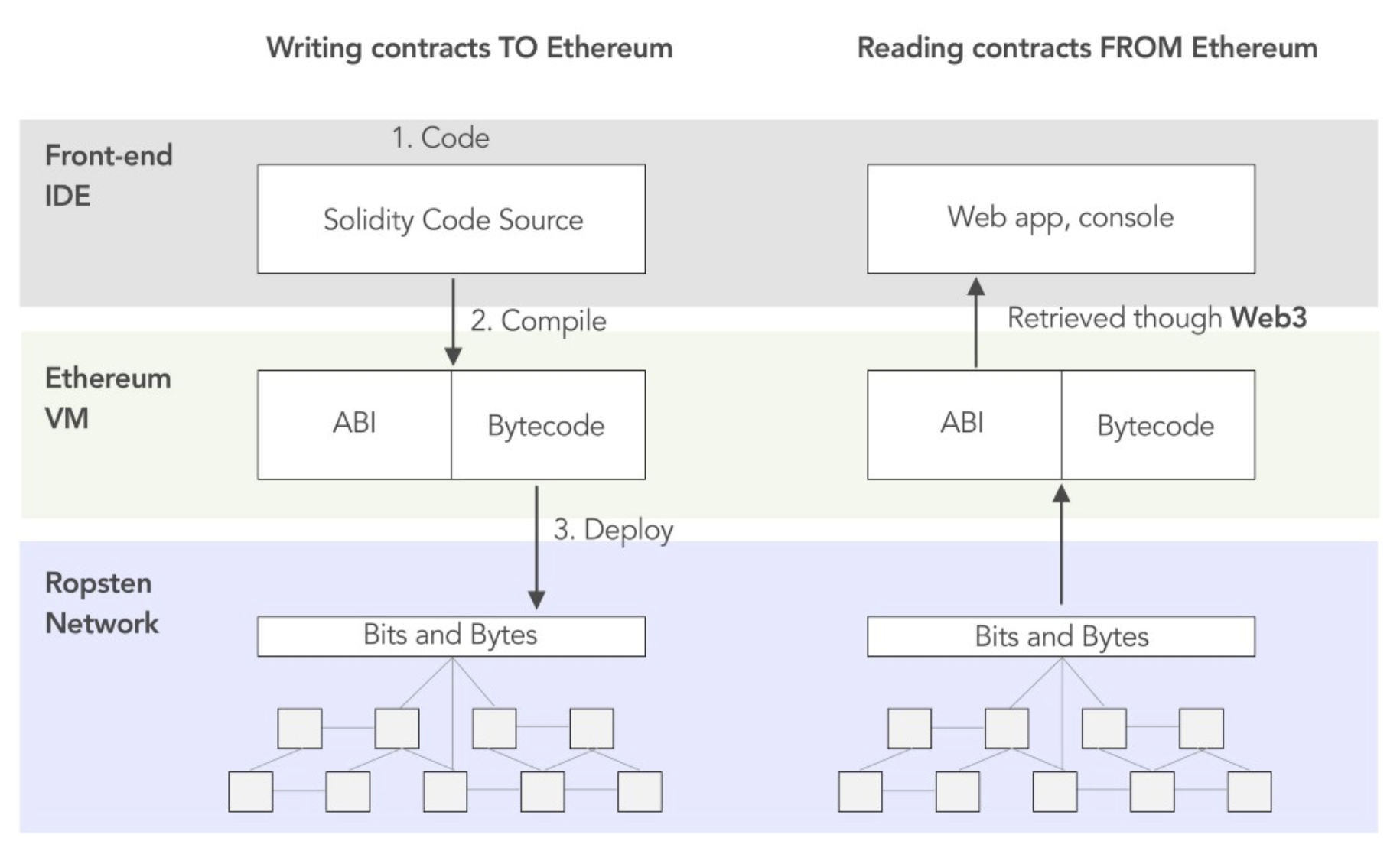
As you can see in the diagram above, if you want to interact with the Ethereum computer in one of a few ways, you must have some important artifacts with you.
If you are writing contracts TO Ethereum (ie. deploying), the contract compilation produces what you need: the contract's bytecode.
If you are reading contracts FROM Ethereum, the contract compilation produces what you need here as well: the contract's ABI.
## Learn More About Ethereum Development
Alchemy University offers [free web3 development bootcamps that explain smart contract communication](https://university.alchemy.com/ethereum) and help developers master the fundamentals of web3 technology. Sign up for free, and start building today!