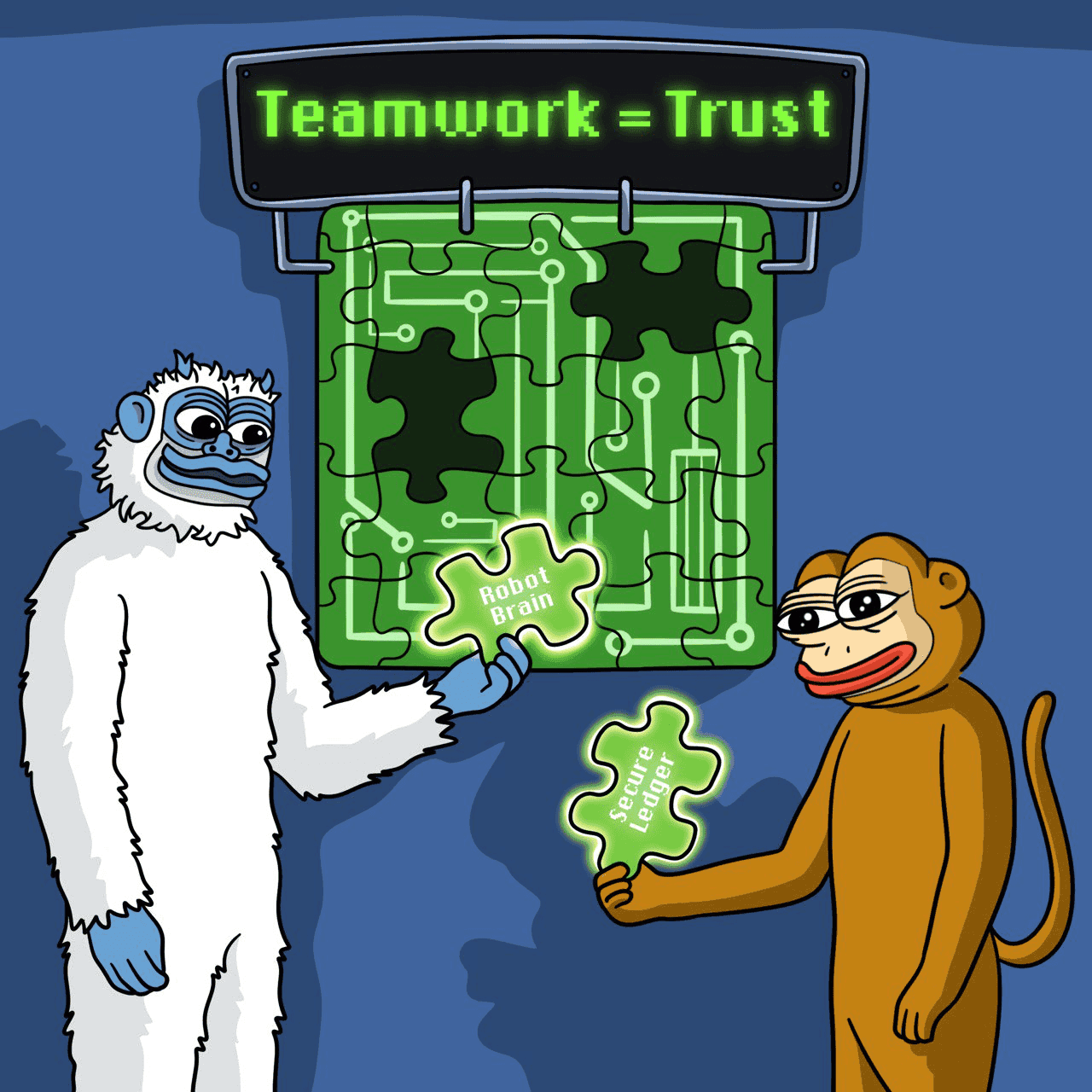
The worlds of Artificial Intelligence (AI) and blockchain are largely separate now, but they’re starting to intersect in interesting ways. You might wonder, what does AI – which is about machine learning, decision-making, automation – have to do with Web3? The answer lies in creating autonomous, trustless systems that can operate transparently and without human intermediaries.
On the Sui blockchain, one notable example is Talus. Talus is developing onchain AI agents designed to automate workflows across DeFi, onchain gaming, and autonomous economies. These agents can execute composable workflows onchain — acting almost like decentralized AI workers that operate transparently in smart contract environments. Combined with blockchain’s transparency and immutability, this creates powerful possibilities for verifiable AI logic and decentralized agent economies.

A few connections:
-
Data Provenance and Integrity: AI systems are hungry for data. But in the era of deepfakes and misinformation, ensuring data integrity is crucial. Blockchain can verify where data came from and whether it was tampered with. For example, an AI model might only want to train on images that are certified authentic (maybe via an NFT that logs origin) to avoid garbage or malicious data. Also, if an AI uses data, blockchain can log that usage for an audit trail (useful for compliance: e.g., proving an AI model didn’t train on certain sensitive data, or did and therefore requires a license payment).
-
Decentralized AI Marketplaces: Projects like SingularityNET or Ocean Protocol envision a world where AI algorithms and datasets are exchanged on a blockchain-based marketplace. If you need a certain AI service (say an image recognition algorithm), you could call it via a smart contract, pay in tokens, and get the result – without going through a big AI company. This decentralizes access to AI capabilities. It’s like a global open marketplace for AI models, where providers earn tokens for their models’ usage. This also ties to composability – one app could string together multiple AI services from different providers seamlessly.
-
AI DAOs / Autonomous Agents: Here’s a sci-fi but plausible scenario: what if a DAO itself had AI agents that help make decisions or even operate autonomously? For example, a trading DAO might deploy AI algorithms to execute trades onchain, under the DAO’s oversight (maybe an AI proposes trades which members vote on or set parameters for). Or an AI agent could roam the web collecting information and then trigger blockchain actions (like paying for data via micropayments). There are concept talks of DAO-controlled AI and AI-controlled DAOs. If we go further, an AI could be given its own wallet and decision rules, essentially becoming an economic actor – it could provide services, earn crypto, pay for resources, and evolve. That’s a bit Westworld-ish (machines economically independent), but simpler forms exist: trading bots that autonomously profit from arbitrage in DeFi – these are AI or algorithmic agents making money and re-investing without human every time. A more beneficial example: an AI charity agent – given a fund, it algorithmically distributes to where impact is highest using onchain data from charities.
-
Verifiable AI and Compute: How do you trust an AI’s result if you can’t see its black-box inner workings? Blockchain can help by verifying some parts of the process. For instance, secure multiparty computation or zero-knowledge proofs could one day let an AI model prove something about its output without revealing the whole model (like “I have correctly computed that this applicant’s credit score is above 700” with a proof, so you trust the credit check was done fairly). Also, decentralized compute networks (like Golem) might let many nodes train parts of a model and agree on the result via consensus or proof-of-computation, to trust it hasn’t been manipulated.
-
AI for Blockchain Efficiency: On the flip side, AI can help blockchains too: optimizing network traffic, predicting and adjusting fees or throughput, detecting fraudulent transactions or anomalies (kind of like how banks use AI for fraud – DeFi protocols could use AI monitors to spot hacking patterns early and trigger safeguards).
💡 Analogy: AI x Blockchain – Memory + Reasoning If AI is the brain, blockchain is the memory. AI can reason, but it needs trustworthy data. Blockchain can’t think, but it never forgets or lies. When combined, they power smart agents that can make transparent, verifiable decisions.
-
Content Creation and NFTs: AI-generated art and content (like from DALL-E, ChatGPT, etc.) is booming. There’s a natural synergy with NFTs – if an AI generates a unique piece of art on demand, mint it as NFT so the user has exclusive ownership of that output. People have done “mint on demand AI art” where each NFT triggers the AI to create a fresh piece. Additionally, managing rights of AI-generated content could use blockchain to track prompts and outputs and who has commercial rights (currently a legal grey area, but tech can help enforce whatever rules are decided by giving traceability).
-
onchain AI models: There have even been experiments in deploying simple AI models into smart contracts that can make decisions onchain. One example: someone put a neural network on Ethereum (as contract code), it was inefficient but conceptually interesting – the idea of an AI that lives entirely on the blockchain and updates itself with onchain data (though gas costs make that tough now, future rollups might allow heavier computation).
One concrete product in this AI-blockchain space is what we saw in the Sui case: Talus on Sui, which is building onchain AI agents purpose-built for decentralized finance (DeFAI) and blockchain-integrated gaming (GameFAI). These agents are designed to autonomously manage tasks like liquidity provisioning, strategy execution, and in-game logic–all running 24/7 onchain. Thanks to Sui’s high throughput and low latency, they operate in real time and without custodial risk. Their behavior can be verified directly onchain, making them more transparent than traditional black-box bots used in algorithmic trading. Talus is also expanding beyond finance into broader “agent economies,” where developers can build tokenized agents that execute workflows onchain with transparent, verifiable behavior. Its Nexus framework is designed to let builders compose, deploy, and scale autonomous agent workflows, with Sui providing the high-throughput execution environment.
Another example: Fetch.ai built a decentralized network for deploying AI “agents” that could, say, find you parking and reserve it (with agent paying in crypto). Or Numerai is a hedge fund that uses AI models crowdsourced from many data scientists, who stake their models on a blockchain (if their model performs well on live data, they earn; if not, they lose stake) – combining AI predictions with crypto staking game theory to crowdsource a meta-AI.
Looking ahead, as AI becomes more ubiquitous (with IoT, autonomous cars, etc.), blockchains might serve as coordination and transaction layers for AI-driven services. You could have machine-to-machine commerce: your self-driving car negotiates with city’s traffic AI for optimal routing, paying micropayments to get green lights – stuff like that might sound far out but conceptually fits an AI-blockchain synergy where algorithms can transact value or trade resources (bandwidth, compute) with each other spontaneously, which requires a common trust layer and token, which blockchains provide.
[IoT Sensor Input] → [onchain Storage] → [AI Model Decision] → [Smart Contract Execution]
One more synergy: ensuring AI ethics and origin – maybe future regulations say “AI outputs need to be labeled and traced.” Blockchain could be that label system: each AI-generated media content is hashed and recorded so you know if something was AI-made or by whom. Or vice versa, each piece of training data could be logged so artists get credit if AI trained on their work (there’s currently debate about AI scrapping art without credit – a blockchain might have allowed artists to register their work and get micro-royalties if used in training an AI, tracked via some protocol).
So, AI & blockchain together aim to produce a world of autonomous economic actors and verifiable AI processes. We can think of it as giving AI agents wallets and blockchain trust, and giving blockchain world AI-powered intelligence. It’s early – but projects like SingularityNET, Fetch, Sui’s Talus, Numerai, etc., are pioneers. As both AI and Web3 mature, their overlap likely will create new industries we haven’t thought of – imagine “smart contract lawyers” as AI bots that read proposals in DAOs and point out issues, or personal AI assistants that manage your crypto portfolio and taxes by interacting directly with dApps on your behalf. The possibilities are wide (and yes, we must consider safety, like not letting rogue AI drain funds – but that’s where clear rules and maybe kill-switches or multi-sig oversight might be needed).