

This guide walks you through making your first Yellowstone gRPC connection and streaming real-time Solana data.
Yellowstone gRPC is supported on both Solana Mainnet and Solana Devnet. The examples below use the Mainnet endpoint (https://solana-mainnet.streaming.alchemy.com); to target Devnet, swap solana-mainnet for solana-devnet in the URL. Both endpoints use the same X-Token auth header and the same pricing.
Before you begin, ensure you have:
- Alchemy Team with PAYG or Enterprise Plan: Yellowstone gRPC is only available to PAYG (Pay-As-You-Go) and Enterprise teams
- Create an Alchemy app: You'll need to create an app in the Alchemy Dashboard to get your endpoint URL and API key
- Get your API key: Your Alchemy API key will be used as the
X-Tokenheader for authentication - Basic understanding of gRPC concepts
- Understanding of Solana's slot and commitment level concepts
Get your endpoint URL and API key from the Alchemy Dashboard.
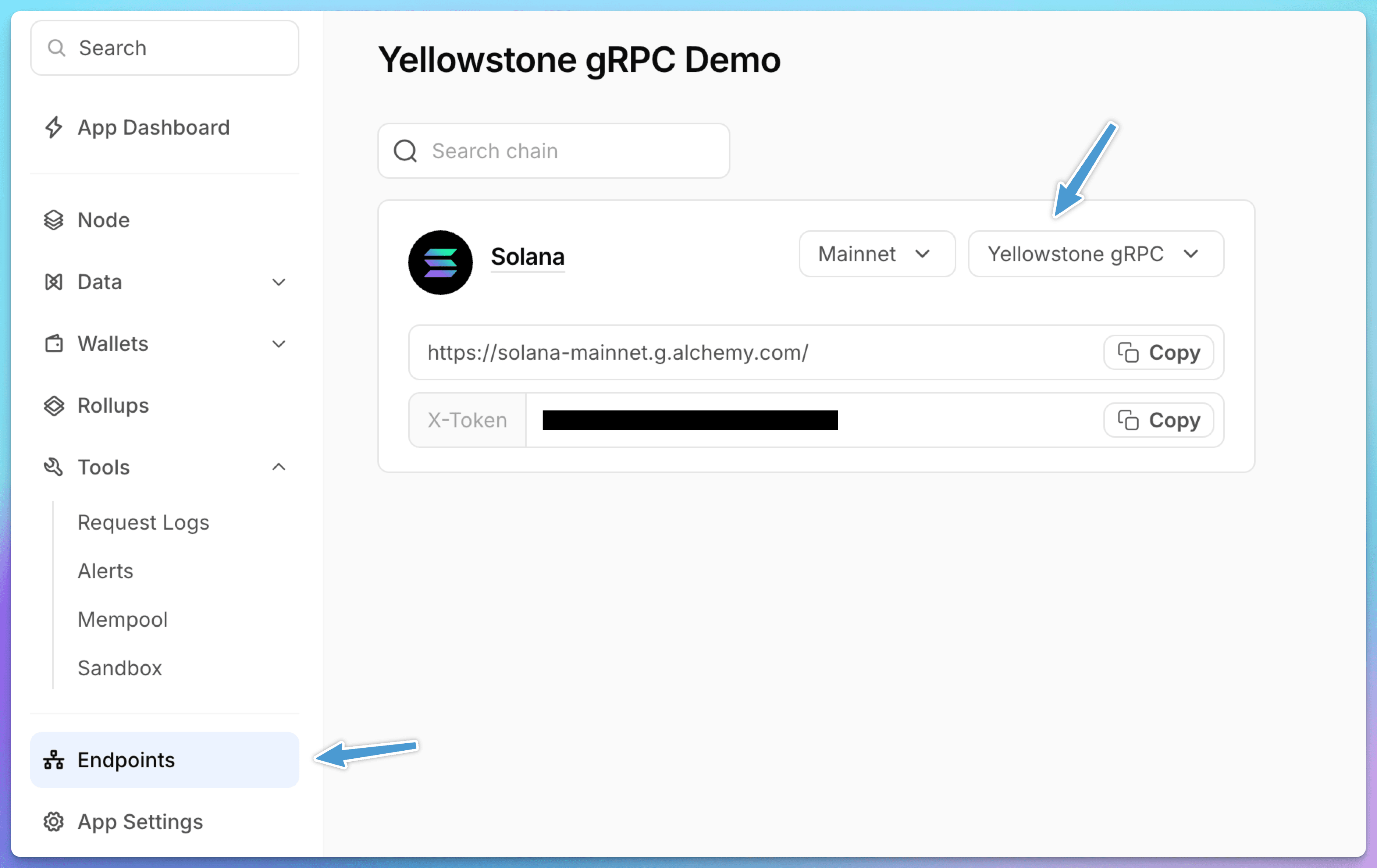
Important: Your Alchemy API key must be passed as the X-Token header in your gRPC requests (not in the URL).
let endpoint = "https://solana-mainnet.streaming.alchemy.com";
let x_token = "ALCHEMY_API_KEY";

let client = GeyserGrpcClient::build_from_shared(endpoint)?
        .tls_config(ClientTlsConfig::new().with_native_roots())?
        .x_token(Some(x_token))?
        .connect()
.await?;Below is a basic example of connecting to Yellowstone gRPC with Rust and streaming all transactions.
use anyhow::Result;
use futures::{sink::SinkExt, stream::StreamExt};
use solana_signature::Signature;
use std::collections::HashMap;
use yellowstone_grpc_client::{ClientTlsConfig, GeyserGrpcClient};
use yellowstone_grpc_proto::geyser::{
    CommitmentLevel, SubscribeRequest, SubscribeRequestFilterTransactions,
    subscribe_update::UpdateOneof,
};

#[tokio::main]
async fn main() -> Result<()> {
    // Set up connection parameters
    let endpoint = "https://solana-mainnet.streaming.alchemy.com";
    let x_token = "ALCHEMY_API_KEY"; // Replace with your Alchemy API key

    // Build and connect the gRPC client with TLS and authentication
    let mut client = GeyserGrpcClient::build_from_shared(endpoint)?
        .tls_config(ClientTlsConfig::new().with_native_roots())?
        .x_token(Some(x_token))? // API key passed as X-Token header
        .connect()
        .await?;

    // Create a bidirectional stream for subscribing to updates
    let (mut tx, mut stream) = client.subscribe().await?;

    // Send subscription request to filter for non-vote, non-failed transactions
    tx.send(SubscribeRequest {
        transactions: HashMap::from([(
            "all_transactions".to_string(),
            SubscribeRequestFilterTransactions {
                vote: Some(false),   // Exclude vote transactions
                failed: Some(false), // Exclude failed transactions
                ..Default::default()
            },
        )]),
        commitment: Some(CommitmentLevel::Confirmed as i32), // Use confirmed commitment level
        ..Default::default()
    })
    .await?;

    // Process incoming transaction updates
    while let Some(Ok(msg)) = stream.next().await {
        if let Some(UpdateOneof::Transaction(tx)) = msg.update_oneof {
            // Extract and display transaction signature
            let sig = tx
                .transaction
                .and_then(|t| Some(Signature::try_from(t.signature.as_slice()).unwrap()))
                .unwrap_or_default();
            println!("Slot: {} | Signature: {}", tx.slot, sig);
        }
    }

    Ok(())
}Yellowstone gRPC supports multiple programming languages. Choose the client that fits your stack:
Official Examples Available:
- Rust - Official Rust Example
- Python - Official Python Example
- TypeScript/JavaScript - Official TypeScript Example
- Go - Official Go Example
Now that you've established your first connection, explore:
- API Reference - Detailed documentation of all filters and options
- Code Examples - See complete working examples
- Best Practices - Learn production patterns and optimization tips