

When you load a website, you probably don’t care whether the server runs Windows, macOS, or Linux—you just want the page to load. Blockchains, on the other hand, are the servers—and they each have their own speed limits, fee schedules, and superpowers. These base blockchains are called Layer 1s (L1s). Think of them like the foundational highways of the crypto economy.
But what happens when traffic jams up or fees spike? Enter Layer 2s (L2s)—networks built on top of Layer 1s that process transactions off-chain (or in batches) and report back. They’re kind of like express lanes added above the main road. For example, Base, a Layer 2 built on Ethereum, allows users to transact with faster speeds and lower fees while still inheriting Ethereum’s security. It posts its final transaction summaries (called “proofs”) to Ethereum, ensuring that all off-chain activity is still verifiable on the main chain. L2s effectively scale Layer 1s, making them more usable without compromising on trust.
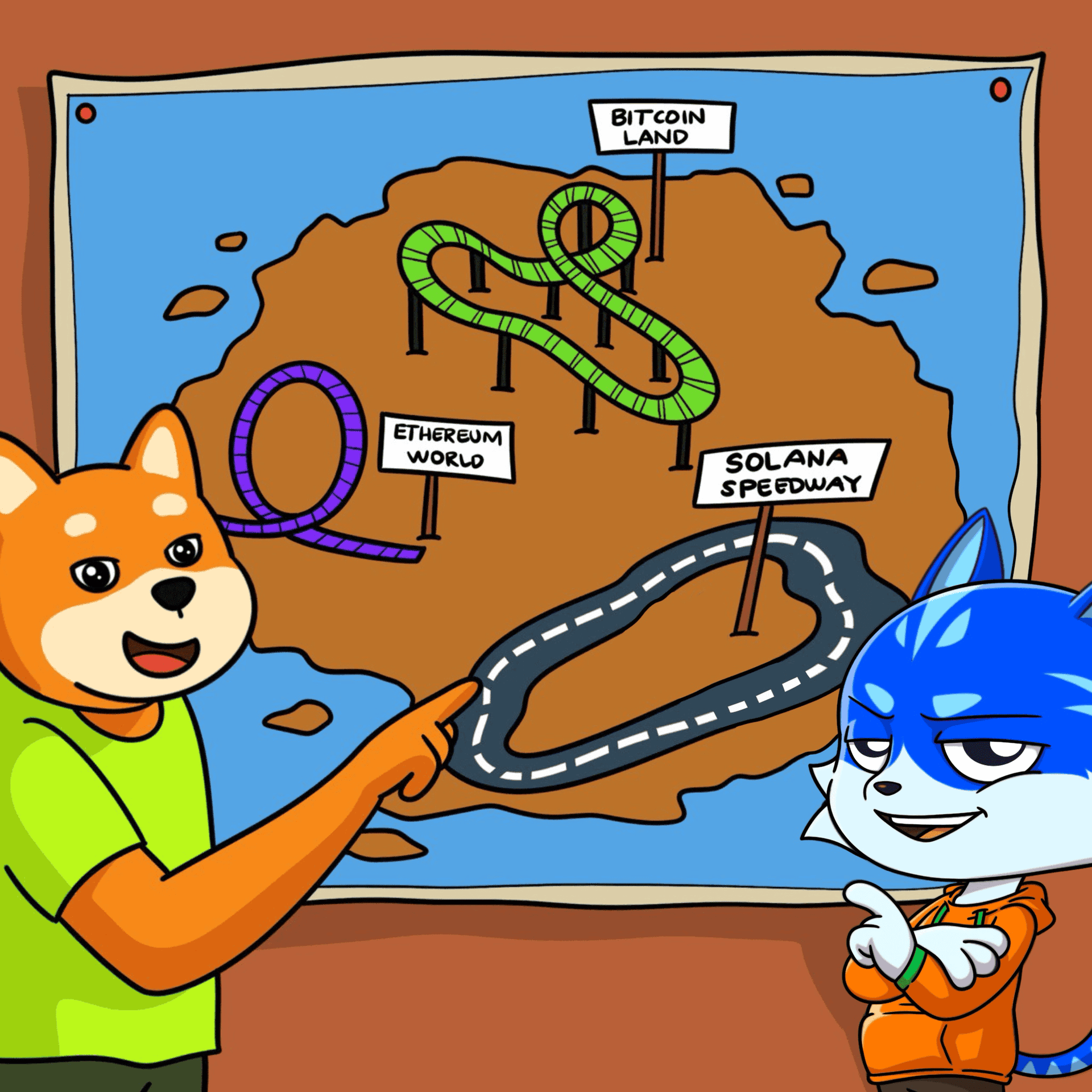
Blockchains can feel like rival theme parks. Each park has its own rides, ticket prices, and safety rules, and visitors hop between them for different experiences. The three headline parks in 2025 are Bitcoin, Ethereum, and Solana with a growing lineup of other chains such as Sui, Base, and XRP Ledger.
| Spot-check (June 2025) | Main “Super-power” | What Students Notice First | Current Fun Fact |
|---|---|---|---|
| Bitcoin (BTC) | Digital gold & store-of-value | Simple, slow but super-secure; you can hold coins like online treasure | 14 nations now list BTC in their strategic reserves, and spot-BTC ETFs manage >$70 B |
| Ethereum (ETH) | World computer for smart contracts | Home base for DeFi, NFTs, DAOs | 70 % of daily activity happens on Layer-2 roll-ups such as Arbitrum, Optimism, Base – “the Ethereum super-chain” |
| Solana (SOL) | Blazing-fast consumer apps | Near-zero fees; mobile “Saga” phone ships with crypto wallet | Handles >65 k transactions per second in stress tests |
| Sui (SUI) | Object-oriented smart-contracts | Friendly for gaming assets & Move language | Finalizes most transfers in <1 s |
| XRP Ledger (XRP) | Bank-to-bank settlements | Cross-border payments with tiny fees | Over 300 financial institutions trial XRP for remittances |
What’s new in 2025?
- Modular blockchains – Ethereum is learning to “delegate chores” to Layer 2 helpers so main-chain traffic jams shrink.
- App-specific chains – Some projects launch their own mini-chains (think “classroom servers”) tuned just for gaming, DeFi, or social apps.
- Bitcoin’s reboot – Without touching its original code, add-ons like Ordinals and Runes let people create collectibles and tokens on the grand-daddy chain.
# Bitcoin (BTC) – From Hobby Project to Sovereign Reserve
In 2009 a single computer quietly began publishing a puzzle called Bitcoin to the internet. Fifteen years later, that puzzle has become a global store-of-value. Hedge funds buy it to hedge inflation, household savers buy tiny fractions through phone apps, and fourteen national treasuries now list bitcoin alongside gold in their official reserves.
The biggest turning point came in January 2024 when U.S. regulators approved spot Bitcoin ETFs. An ETF works like a transparent jar: you can buy a share of the jar through a stockbroker while specialists behind the scenes drop real bitcoin in to keep the jar honest. Within a year the flagship ETF (BlackRock’s IBIT) crossed $70 billion—faster than any other fund in history. That watershed moment told pension funds and insurance companies that bitcoin had grown-up guardrails. It also unlocked a new “supply line” between Wall Street money markets and onchain liquidity: ETF dealers now shuttle coins back and forth daily, often settling in stablecoins (digital dollars) when banks are closed.
# Ethereum (ETH) – The “World Computer” Becomes a Super-Chain
Where Bitcoin stores value, Ethereum runs programs. Smart contracts—little robots living inside the blockchain—let anyone create a lending pool, an online game, or a crowdfund in just a few lines of code. By mid-2025, however, Ethereum’s main highway had grown as busy as a holiday freeway. The solution was to build Layer-2 roll-ups, side roads that handle transactions in bulk and post the receipts back to Layer 1 for security.
Arbitrum, Optimism, and Base now process more payments per day than Ethereum itself, often for less than half a cent. The roll-ups share infrastructure, so developers talk about a single “Ethereum super-chain.” This modular approach—security in one place, execution in many—means a collectible card game can run three million trades per hour without crashing a DeFi lending app next door. It also teaches a crucial lesson: blockchains don’t have to choose between security and speed if they learn to outsource the heavy lifting.
# Non-EVM Stars – Why Variety Matters
For all their strengths, Bitcoin and Ethereum aren’t perfect for every job—just as a bicycle, a sports car, and a cargo ship each excel at different trips.
-
Solana gears itself for sheer speed. It stamps transactions in milliseconds by running a cryptographic “history clock,” so popular games and social apps avoid waiting rooms. A Solana-branded Saga phone even ships with a built-in wallet, hinting that blockchains may hide behind everyday consumer electronics.
-
Sui is a newer Layer 1 chain that is built for global scale infinitely thanks to Directed Acyclic Graph (DAG) and parallel transaction execution. Sui utilizes a language called Move and has an innovative object-oriented model which treats every onchain asset as a programmable object. That makes designing complex item inventories for games feel more like building in Roblox Studio than writing bank software.
-
XRP Ledger targets financial institutions. Its built-in DEX lets banks swap currencies instantly. Over 300 remittance partners have tested XRP, and it's also one of the few blockchains advancing ISO 20022 compatibility, the global messaging standard for financial institutions. This alignment could smooth integration with traditional banking systems and SWIFT messaging in the years ahead.
Different designs create healthy competition: speed, programmability, and compliance each get their own “laboratory,” and future developers—including today’s middle-school coders—will be able to choose the best tool for the story they want to tell.