

Portfolio APIs include everything you need to build a view of a user's assets: fungibles, NFTs, and their transactions.
- Multi-chain: All Portfolio APIs are multi-chain -- get all the data you need in a single API request, instead of parallelizing dozens of calls across different networks.
- Powerful: Query for the metadata you need (e.g. cached images, token metadata, prices) within the same API call.
- Constantly improving: These APIs are continuously improving, based on customer feedback.
- Long-term partners: We have 7+ years of experience supporting the largest onchain customers and will be around to support you for the long term.
- Scalable: These APIs power some of the biggest wallets in the space -- rest assured that we can scale with you.
| Get Tokens By Wallet | NFTs By Wallet | Transfers By Wallet (Beta) |
|---|---|---|
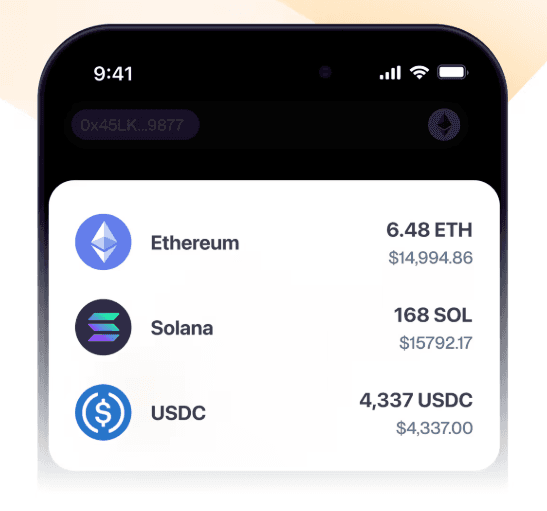 |  |  |
| Ideal for: Multi-chain token experiences, balance indexing How it works: Call an API to get balances, metadata, and prices. | Ideal for: NFT drops, token gating, analytics, wallets, marketplaces How it works: Call an API to return multi-chain and complete NFT data. | Ideal for: Wallets How it works: Get transfer history for one wallet across multiple networks. |
The Portfolio API has two partial-error behaviors. The token and NFT endpoints use one behavior. Transfers By Wallet uses another behavior.
This behavior applies to these endpoints:
These endpoints can return results from some networks when other networks fail. The response has HTTP 200 and includes a top-level error object.
The error object lists the networks that failed. The successful results remain in the top-level data object.
The response omits the error key when all networks succeed.
Response shape
{
  "data": { /* successful results, possibly an empty array */ },
  "error": {
    "message": "Failed to fetch tokens on certain networks",
    "partialErrors": [
      { "network": "eth-mainnet", "message": "Internal server error" }
    ]
  }
}
The message fields contain human-readable context. Do not use these fields for programmatic decisions.
Pagination and retries
- A failed network is not present in the next page. The
pageKeydoes not retry that network. - A network can occur more than once in
partialErrorswhen multiple request entries use that network. - Retry only the listed networks. Use a new request and stop after a fixed number of attempts.
- Return the successful data to the client. Do not discard the response because it contains
error. - On Tokens By Wallet, the top-level
erroris different fromdata.tokens[].error. The nested error describes a token metadata or price error.
Transfers By Wallet (Beta) returns successful items in the top-level transfers array.
A partial error can describe a failed network. It can also describe one unsupported category on a network.
If only one category is unsupported, the same network can still return transfers from its other requested categories. Always process the transfers array.
The response has HTTP 200 in both cases. The response omits the error key only when the full request succeeds.
Each transfer partial error has a required state:
unsupported: The network or category is not supported. Do not retry the same request.timeout: The network query timed out. You can retry it with a fixed attempt limit.error: The network query failed. You can retry it with a fixed attempt limit.
The message fields contain human-readable context. Use state, not the message text, for programmatic decisions.
Pagination and retries
- A fully failed network is not present in the next page. The
pageKeydoes not retry that network. - An unsupported category does not remove the network from pagination. Supported categories on that network remain in the next page.
- The same category partial error can occur on later pages.
- Do not retry an
unsupportederror unless you change the network or category selection. - Retry
timeoutanderrorstates only for the listed networks. Use a new request and stop after a fixed number of attempts. - Continue to use
pageKeyfor successful networks and supported categories. - Return the successful transfers to the client. Do not discard the response because it contains
error.
Get in touch with us directly:
Email: [email protected]