

Before reading this article you should have a clear understanding of EVM Traces.
trace_transaction is an RPC method exposed by the Openethereum and Erigon Ethereum clients. You can get the EVM traces of a previously executed transaction using this method. This can be useful for debugging purposes, or for understanding how a transaction works.
This method only takes one parameter which is the transaction hash of the transaction whose traces you wish to get:
Hash- Transaction hash
params: ["0x17104ac9d3312d8c136b7f44d4b8b47852618065ebfa534bd2d3b5ef218ca1f3"]This method returns the traces of the given transaction as a response:
array- Traces of the given transaction
To use the trace_transaction method you need to be in pay as you go or enterprise tier. Sign up for Alchemy or upgrade your account.
You can call the trace_transaction method by providing the transaction hash of the transaction you wish to trace. You can find this by looking up the transaction on a block explorer. Once you have the transaction hash, you can call the "trace_transaction" method with it as follows:
curl https://eth-mainnet.g.alchemy.com/v2/your-api-key \
-X POST \
-H "Content-Type: application/json" \
-d '{"method":"trace_transaction","params":["0x17104ac9d3312d8c136b7f44d4b8b47852618065ebfa534bd2d3b5ef218ca1f3"],"id":1,"jsonrpc":"2.0"}'{
"jsonrpc": "2.0",
"result": [
{
"action": {
"callType": "call",
"from": "0x83806d539d4ea1c140489a06660319c9a303f874",
"gas": "0x1a1f8",
"input": "0x",
"to": "0x1c39ba39e4735cb65978d4db400ddd70a72dc750",
"value": "0x7a16c911b4d00000"
},
"blockHash": "0x7eb25504e4c202cf3d62fd585d3e238f592c780cca82dacb2ed3cb5b38883add",
"blockNumber": 3068185,
"result": {
"gasUsed": "0x2982",
"output": "0x"
},
"subtraces": 2,
"traceAddress": [],
"transactionHash": "0x17104ac9d3312d8c136b7f44d4b8b47852618065ebfa534bd2d3b5ef218ca1f3",
"transactionPosition": 2,
"type": "call"
},
{
"action": {
"callType": "call",
"from": "0x1c39ba39e4735cb65978d4db400ddd70a72dc750",
"gas": "0x13e99",
"input": "0x16c72721",
"to": "0x2bd2326c993dfaef84f696526064ff22eba5b362",
"value": "0x0"
},
"blockHash": "0x7eb25504e4c202cf3d62fd585d3e238f592c780cca82dacb2ed3cb5b38883add",
"blockNumber": 3068185,
"result": {
"gasUsed": "0x183",
"output": "0x0000000000000000000000000000000000000000000000000000000000000001"
},
"subtraces": 0,
"traceAddress": [
0
],
"transactionHash": "0x17104ac9d3312d8c136b7f44d4b8b47852618065ebfa534bd2d3b5ef218ca1f3",
"transactionPosition": 2,
"type": "call"
},
{
"action": {
"callType": "call",
"from": "0x1c39ba39e4735cb65978d4db400ddd70a72dc750",
"gas": "0x8fc",
"input": "0x",
"to": "0x70faa28a6b8d6829a4b1e649d26ec9a2a39ba413",
"value": "0x7a16c911b4d00000"
},
"blockHash": "0x7eb25504e4c202cf3d62fd585d3e238f592c780cca82dacb2ed3cb5b38883add",
"blockNumber": 3068185,
"result": {
"gasUsed": "0x0",
"output": "0x"
},
"subtraces": 0,
"traceAddress": [
1
],
"transactionHash": "0x17104ac9d3312d8c136b7f44d4b8b47852618065ebfa534bd2d3b5ef218ca1f3",
"transactionPosition": 2,
"type": "call"
}
],
"id": 0
}Here is the link to the transaction on Etherscan whose EVM trace is given above in the Response.
You can get the whole trace tree for a transaction and analyze what exactly happened during the transaction execution. The trace tree also returns the gas used for each action, the output values, and the revert reason (if the transaction failed). For example, in the trace image below you can see that the transaction failed due to an "Out of gas" exception, which means that there was not enough gas to complete the transaction.
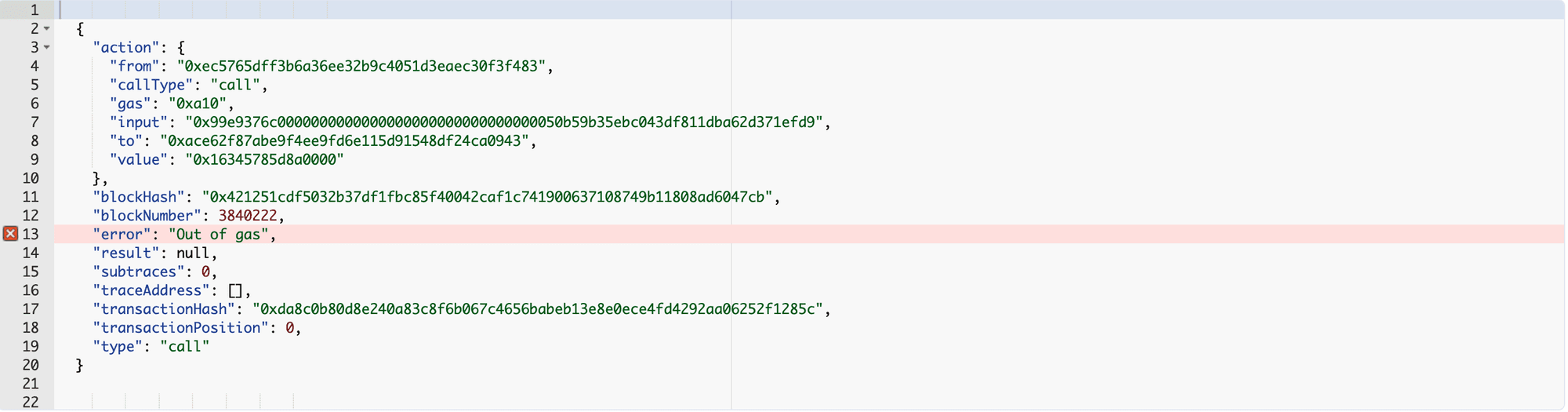
Here is the link to the above-defined transaction on Etherscan.
You can get the traces for a previously executed transaction using trace_call. Transaction tracers help us better understand the flow of a transaction. They extract the EVM traces for a transaction and display them in a way that’s readable by us.

As you can see it’s clear from the execution trace that the caller called the transfer function of the TetherToken contract and the contract transferred 285 USDT from the caller to the target address.
Transaction traces can be used to analyze the performance of smart contracts by looking at the number of actions it takes for each transaction to be processed. This information can be used to identify bottlenecks and optimize the contract for better performance.
In conclusion, the trace_transaction method is a valuable tool for debugging transactions. It provides a step-by-step record of the execution of a transaction and can be used to identify errors and optimize code.