Blockchain RPC infrastructure evaluation guide for enterprises

Written by Alchemy

When your application leverages the blockchain, choosing the right RPC (Remote Procedure Call) infrastructure provider directly impacts your customer experience at scale. Your RPC provider handles every interaction between your application and the blockchain—determining whether transactions complete in seconds or minutes, whether your application stays online during peak demand, and whether you can deliver the seamless, reliable experiences users expect.
Many enterprises approach this decision without the proper framework, leading to costly migrations, compliance gaps, or performance issues that undermine adoption. This guide provides a comprehensive evaluation framework for enterprise decision-makers, technical architects, and procurement teams. Whether your end users are blockchain-native crypto enthusiasts or mainstream consumers who've never touched web3, we've organized the critical questions you need to ask—starting with universal criteria that apply to every enterprise, then diving into specialized considerations for financial services and consumer applications.
Universal evaluation criteria: essential for all enterprises
These foundational questions apply regardless of your specific use case or industry.
Performance and reliability
What are your uptime SLAs and historical uptime metrics? Enterprise operations demand the highest levels of reliability. Look for providers offering 99.99% uptime guarantees backed by financial penalties. Request access to their public status page and ask for detailed incident post-mortems from the past 12 months. Understand what qualifies as downtime and how they calculate uptime.
What is your average response time and latency across different regions? Global enterprises need consistent performance regardless of where requests originate. Ask for detailed latency metrics (p50, p95, p99) across all regions where you operate. Request information about their points of presence and how they route traffic for optimal performance.
Use public RPC provider benchmarks to compare latency, success rates, and failed requests before relying on vendor-provided performance claims.
How do you handle peak load and traffic spikes? Enterprise workloads can be unpredictable, especially during market events or business-critical periods. Ask about their capacity planning, auto-scaling capabilities, and headroom above your contracted throughput. Request case studies from enterprises with similar scale and traffic patterns.
What redundancy and failover mechanisms do you have in place? Single points of failure are unacceptable for enterprise infrastructure. Ask about multi-region redundancy, automatic failover procedures, data replication strategies, and how they ensure zero data loss during failovers. For providers offering dedicated infrastructure, ask whether dedicated deployments are configured as redundant clusters (multiple nodes per chain per region) rather than single nodes, and whether traffic can automatically fail over to shared infrastructure when your dedicated capacity is exceeded. Understand their disaster recovery testing schedule and procedures.
What is your infrastructure architecture? Understanding whether they run bare metal servers, use cloud providers, or employ a hybrid approach impacts your risk assessment. Ask about their relationships with underlying infrastructure providers and what happens if those relationships change.
Supported networks and capabilities
Which blockchain networks and protocols do you support? Enterprises often need to interact with multiple networks. Verify support for public chains (Ethereum, Solana, Bitcoin), private/permissioned networks (Hyperledger, Corda), and Layer 2 solutions relevant to your use case. Ask about their roadmap for adding new networks.
Do you support both public and private node deployment options? Some enterprise use cases require private nodes or on-premises deployment. Ask whether they support dedicated nodes, single-tenant clustered deployments, virtual private clouds, hybrid cloud configurations, or on-premises installations. For dedicated offerings specifically, ask whether you can deploy custom tracers or binaries directly on your nodes (important for simulation, tracing, and indexing workloads), what regions are available, and whether hardware configurations can be tailored to your traffic shape. Understand the performance and pricing differences between options, including whether dedicated infrastructure uses fixed monthly pricing or per-request billing.
What are your archive node capabilities? Enterprise applications often require historical data access for auditing, reporting, or analytics. Archive nodes are expensive to maintain, so ask about data retention periods, query performance on historical data, and whether archive access requires a premium tier.
What enhanced APIs and services do you offer beyond basic RPC? Efficiency matters at enterprise scale. Ask about value-added services like transaction bundling, gas optimization, decoded transaction data, token APIs, webhook notifications, and blockchain analytics that can reduce your development overhead.
Security and compliance
What security certifications and attestations do you maintain? Enterprise procurement requires documented security practices. At minimum, look for SOC 2 Type II certification. Depending on your industry, you may also need ISO 27001, PCI DSS, FedRAMP, or industry-specific certifications. Request copies of recent audit reports.
How do you handle compliance with global data protection regulations? Enterprises operating internationally must comply with GDPR, CCPA, and other regional privacy laws. Ask about data residency options, data processing agreements, their role as data processor vs. controller, and how they handle data subject requests.
What is your vulnerability management and patching process? Ask about their security testing schedule, penetration testing frequency, bug bounty programs, and typical time-to-patch for critical vulnerabilities. Understand how they communicate security issues to customers.
How do you manage API keys and authentication? Beyond basic API keys, enterprises need sophisticated access control. Ask about OAuth 2.0 support, SAML integration, role-based access control (RBAC), API key rotation procedures, IP allowlisting, and support for your existing identity management systems.
What DDoS protection and rate limiting do you provide? Your blockchain endpoints are potential attack vectors. Ask about their DDoS mitigation strategies, whether protection is included or additional cost, and how they handle sophisticated application-layer attacks.
Do you maintain detailed audit logs and support SIEM integration? Enterprise security teams need comprehensive logging. Ask about log retention periods, what events are logged, log format and structure, and whether they support integration with common SIEM tools like Splunk, Sumo Logic, or Azure Sentinel.
What is your incident response and breach notification policy? In regulated industries, you may be required to report security incidents within specific timeframes. Understand their incident response procedures, notification timelines, and whether they've experienced any security incidents in the past 24 months.
Do you carry cyber insurance and what does it cover? Ask about their cyber insurance coverage limits, what scenarios are covered, and whether customers are named as additional insureds. This provides an additional layer of protection for your enterprise.
Business continuity and risk management
What is your disaster recovery plan and how often is it tested? Request documentation of their disaster recovery procedures, including Recovery Time Objective (RTO) and Recovery Point Objective (RPO). Ask how often they conduct disaster recovery drills and when the last test occurred.
What is your business continuity plan if your company faces financial difficulties? Understanding vendor stability is critical for long-term partnerships. Ask about their financial backing, runway, profitability status, and what provisions exist to protect customers if the company is acquired or goes out of business.
How do you manage third-party dependencies? Your provider likely depends on cloud infrastructure, network providers, and other services. Ask about their vendor management program, how they assess third-party risk, and what alternatives exist if a critical vendor relationship fails.
What happens during a major blockchain network disruption? When the underlying blockchain faces issues (network splits, consensus failures, major upgrades), how does your provider respond? Ask for examples of how they've handled past network incidents.
Pricing and commercial terms
What is your pricing model and how predictable are costs? Enterprise budgets require predictability. Understand whether pricing is based on compute units, requests, data transfer, or a combination. Ask for detailed examples showing how typical workloads translate to costs, and whether they can cap monthly spend.
What volume discounts and enterprise pricing are available? As an enterprise customer, you should receive preferential pricing. Ask about volume commitments, annual prepayment discounts, and whether they offer graduated pricing tiers that automatically reduce costs as usage grows.
What are the contract terms and what flexibility do you offer? Understand minimum contract length, renewal terms, price escalation clauses, and termination provisions. Ask about flexibility to adjust committed volumes and what happens if you significantly exceed or underutilize your commitment.
Are there any hidden costs or additional fees? Beyond base pricing, ask about charges for premium support, archive node access, additional API methods, data egress, WebSocket connections, or accessing usage beyond certain thresholds. Get complete pricing transparency upfront.
What are the financial penalties for SLA violations? SLAs without teeth are meaningless. Understand service credits for downtime, how to claim them, caps on total credits, and whether credits are your sole remedy for service failures.
Vendor management and governance
Who will be our primary points of contact? Enterprise relationships require clear ownership. Ask about dedicated account management, technical account managers, customer success resources, and escalation procedures for urgent issues.
What is your change management and communication process? Enterprises need advance notice of changes. Ask how they communicate planned maintenance, deprecations, API changes, and pricing modifications. Understand typical notice periods and whether you have input on change timing.
How do you handle service requests and feature requests? Ask about their product roadmap process, how customer feedback influences development priorities, and whether enterprise customers get early access to new features or beta programs.
What governance structure exists for enterprise customers? Some providers offer customer advisory boards, executive business reviews, or other governance mechanisms. Ask what's available and how enterprise customers influence the product direction.
Support and service delivery
What support tiers are available and what's included? Compare support levels including response time SLAs, available channels (email, phone, chat, dedicated Slack), support hours, and whether you get access to solutions architects or technical account managers.
What is your typical response and resolution time for critical issues? SLAs should specify both initial response time and resolution targets for severity levels. Ask to see their actual performance against these SLAs and what percentage of issues are resolved within target timeframes.
Do you provide onboarding and implementation support? Enterprise implementations are complex. Ask about professional services for architecture reviews, implementation assistance, performance optimization, and training for your technical teams.
What ongoing optimization and advisory services do you provide? Beyond break-fix support, ask whether they proactively monitor your usage patterns, recommend optimizations, conduct quarterly business reviews, and help you stay current with blockchain best practices.
Monitoring and observability
What monitoring and alerting capabilities do you provide? Enterprise teams need real-time visibility. Ask about dashboards, custom alerting based on your thresholds, integration with your existing monitoring tools, and whether they provide public status pages.
What metrics and analytics are available? Beyond basic uptime monitoring, ask about detailed performance metrics, usage analytics, cost analysis tools, and whether data can be exported to your business intelligence platforms.
How do we track and manage our API usage across teams? Large enterprises need usage attribution. Ask about tagging, cost centers, department-level reporting, and whether you can set spending limits or alerts for different business units.
Do you provide transparency into your infrastructure health? Ask whether they publish real-time infrastructure metrics, what visibility you have into the health of nodes serving your requests, and whether you can access detailed logs for debugging. For dedicated deployments, ask whether you get node-level observability (e.g., Grafana dashboards covering node health, request patterns, and cluster performance) rather than aggregate metrics alone.
Integration and migration
How easy is it to integrate with our existing systems? Ask about SDK availability for your technology stack, sample code and reference architectures, CI/CD pipeline integration, and whether they provide technical resources to assist with integration.
What migration support do you offer? If you're switching from another provider or self-hosted nodes, ask about migration planning assistance, data migration tools, parallel running support, and how to minimize downtime during cutover.
Can you support our hybrid or multi-provider strategy? Some enterprises want redundancy across providers. Ask whether they support hybrid architectures, how to implement active-active or active-passive configurations, and any restrictions on using their service alongside competitors.
What is your policy on vendor lock-in? Avoid providers using proprietary APIs. Ensure they use standard JSON-RPC interfaces and open protocols so you maintain flexibility to change providers if needed.
For financial services & payment infrastructure: additional critical questions
If your enterprise is building payments infrastructure, stablecoin services, trading platforms, custody solutions, or other financial applications, these additional questions are essential.
Regulatory compliance and governance
What regulatory frameworks do you operate under? Ask about their registration status with relevant authorities (FinCEN, state money transmitter licenses, international equivalents), any regulatory examinations they've undergone, and their strategy for staying compliant as regulations evolve.
How do you support our compliance obligations? Understand what compliance-related documentation they provide (audit reports, compliance matrices, data processing agreements), whether they'll complete your vendor questionnaires, and how they support your audit requirements.
What controls exist for transaction monitoring and sanctions screening? Financial institutions may need to screen transactions against OFAC sanctions lists or flag suspicious activity. Ask what tools or APIs they provide to support these requirements, or how their infrastructure integrates with your compliance systems.
Can you support data residency and sovereignty requirements? Financial regulations often require data to remain within specific geographic boundaries. Ask about regional deployment options, where data is processed and stored, and how they ensure compliance with data localization requirements across jurisdictions. If your obligations require single-tenant infrastructure in specific regions, ask whether the provider offers dedicated, single-tenant deployments in those regions and whether the underlying hardware can be configured to your requirements.
How do you handle requests from law enforcement or regulators? Understand their policies for responding to subpoenas, warrants, or regulatory inquiries. Ask about their track record with regulatory examinations and how they notify customers when legally permitted.
Do you maintain segregation of customer funds and data? If you're handling customer assets, ask whether their infrastructure supports logical separation of customer data and whether they can provide dedicated infrastructure that's isolated from other customers. For institutions that need to demonstrate to auditors that no other customer's traffic, code, or data has touched their environment, look specifically for single-tenant clustered deployments backed by SOC 2 Type II controls — Alchemy's Dedicated Clusters are one example, providing fully isolated, single-tenant node infrastructure with audit-ready controls and the option to deploy custom tracers or binaries directly on your nodes.
Financial services-specific security
What anti-money laundering (AML) controls do you have? While infrastructure providers aren't typically regulated as money services businesses, ask how they ensure they're not facilitating illicit activity and what customer due diligence they perform.
How do you ensure transaction finality and immutability? In financial services, you can't afford to act on transactions that might be reversed. Ask how they handle finality, whether they support finality callbacks, confirmation depth recommendations, and what guarantees they can provide around transaction settlement.
What fraud detection and prevention capabilities exist? Ask whether they provide tools to detect unusual patterns, rate limiting to prevent abuse, or integration points with fraud detection systems. Understand how quickly they can block compromised API keys.
Do you support multi-signature and hardware security module (HSM) integration? High-value financial operations often require multi-sig wallets or HSM-backed key management. Ask about their support for these security models and whether they offer key management as a service.
Financial operations and reconciliation
What support do you provide for financial reconciliation? Financial institutions need detailed transaction records for reconciliation. Ask about transaction receipt guarantees, idempotency handling, detailed transaction logs with timestamps, and whether they provide reconciliation reports.
How do you handle failed transactions and retries? In payments, understanding transaction state is critical. Ask how they handle nonce management, gas price estimation, transaction replacement, and whether failed transactions count against your usage limits.
Can you support high-value transaction workflows? For security and compliance, you may need to flag or delay high-value transactions. Ask if they offer transaction monitoring tools, approval workflows, or can support custom logic for transaction authorization.
What reporting capabilities do you offer for financial audits? Ask about historical reporting, audit trails, the ability to export complete transaction histories, and whether reports can be customized to meet your specific audit requirements.
Business continuity for financial services
What is your RTO/RPO for financial services customers? Financial operations have zero tolerance for data loss. Ask about guaranteed recovery time objectives and recovery point objectives specifically for financial services customers, which may differ from standard SLAs.
Do you maintain errors and omissions (E&O) insurance? Beyond cyber insurance, E&O insurance protects against professional negligence or mistakes in service delivery. Ask about coverage limits, whether financial losses are covered, and whether customers are named as loss payees.
What is your approach to change management for critical systems? Financial infrastructure requires careful change control. Ask about their change approval process, how they test changes that might impact financial operations, and whether you can participate in beta testing.
How do you handle blockchain hard forks and network upgrades? Network changes can impact financial operations. Ask about their notification process for upcoming forks, how they handle chain splits, whether they support both sides of contentious forks, and their testing process before major network upgrades.
Financial services pricing considerations
How do you charge for failed transactions? In financial applications, failed transactions (insufficient gas, rejected by smart contract) are common. Clarify whether these count against compute units and how this impacts your cost model.
What pricing predictability can you offer for financial operations? Budget certainty is critical for financial services. Ask about fixed-price contracts, spending caps, and whether they can provide predictable pricing despite blockchain network fee volatility. For high-throughput or specialized workloads, ask whether dedicated infrastructure with fixed monthly pricing (rather than per-request billing) is available.
Do you offer pricing models based on transaction value? Some financial services providers may prefer pricing tied to transaction volume or value rather than compute units. Ask about alternative pricing structures for financial use cases.
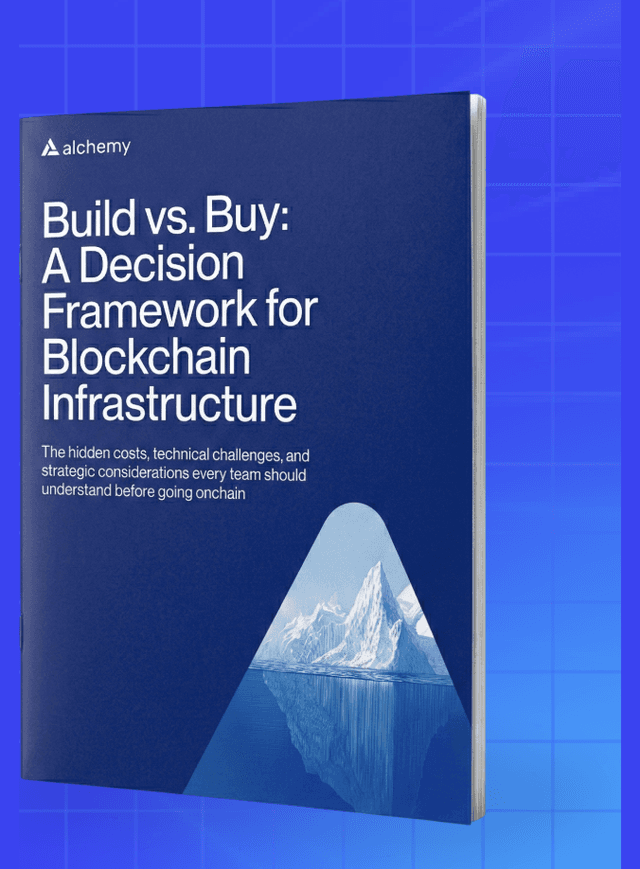
Build vs. Buy: Blockchain Infrastructure
Before you hire an infra team, read this: building in-house can cost $850K–$1M+ a year before you serve a single production request. See the full cost breakdown.
For consumer applications & digital experiences: additional key questions
If your enterprise is building consumer-facing blockchain applications—whether gaming, loyalty programs, digital collectibles, social platforms, or Web3 experiences—these questions will help you deliver exceptional user experiences at scale.
User experience and onboarding
What wallet and authentication solutions do you offer? Consumer adoption depends on seamless onboarding. Ask about embedded wallet solutions, social login integration (Google, Apple, etc.), email-based wallet creation, and whether users can get started without understanding Web3 concepts.
How do you handle gasless transactions and gas sponsorship? Gas fees are a major barrier to consumer adoption. Ask about their gas manager capabilities, how many gasless transactions they can process per second, pricing models for sponsored gas, spending limits, and whether you can set rules for which transactions get sponsored.
What is the time-to-first-transaction for new users? Consumer apps need instant gratification. Ask about their wallet creation speed, whether transactions can be submitted immediately, and what the end-to-end latency is from user signup to first confirmed transaction.
Do you support account abstraction and smart wallets? Modern consumer apps benefit from smart contract wallets that enable features like social recovery, session keys, and batched transactions. Ask about their smart wallet implementation, ERC-4337 support, and what advanced features are available.
How do you handle wallet recovery? Consumers lose seed phrases. Ask about social recovery mechanisms, email backup, multi-device sync, and how your app can help users recover access without compromising security.
Performance for consumer scale
What throughput can you support during viral moments? Consumer apps can explode overnight—going from thousands to millions of users in days. Ask about their maximum throughput, auto-scaling response time, whether there are caps that would kick in during viral growth, and case studies of applications that successfully scaled on their platform.
How do you handle NFT minting and drops at scale? NFT drops can generate massive transaction spikes. Ask about their experience supporting large-scale mints, whether they offer queuing mechanisms, how they handle mempool competition, and pricing for burst workloads.
What is your WebSocket stability and capacity? Real-time features like live feeds, notifications, and multiplayer experiences depend on WebSockets. Ask about concurrent connection limits, reconnection handling, whether subscriptions persist across disconnections, and pricing for WebSocket usage.
Can you support real-time features like leaderboards and live activity? Consumer apps often need real-time blockchain data. Ask about their data freshness guarantees, whether they offer filtered subscriptions to reduce bandwidth, and latency from chain to your application.
Consumer-focused APIs and tools
What NFT-specific features and APIs do you offer? If your app involves digital collectibles, you'll need specialized tools. Ask about NFT metadata APIs, automatic IPFS resolution, thumbnail generation and caching, rarity calculations, collection analytics, and whether they support all major NFT standards across multiple chains.
Do you provide token and pricing APIs? Consumer apps often need to display token balances and values. Ask about real-time token price feeds, multi-chain token balance APIs, transaction history, and whether they support long-tail tokens beyond top 100.
What notification and webhook capabilities do you offer? Engaging users requires timely notifications. Ask about webhook reliability, filtering options, whether they support user-specific notifications, delivery guarantees, and retry logic.
Can you help with wallet portfolio and transaction history? Consumer apps need to show users their activity. Ask about APIs for transaction history, portfolio valuation over time, categorized transactions, and whether data can be exported for tax purposes.
Developer velocity and iteration
How fast can we deploy and test new features? Consumer apps need to iterate quickly based on user feedback. Ask about testnet support and faucets, how easy it is to switch between networks, local development tools, and whether they offer sandbox environments.
What pre-built UI components and templates do you offer? Shipping faster means reusing components. Ask about wallet connection buttons, transaction status displays, NFT galleries, token swap interfaces, and whether these components are customizable to match your brand.
Do you provide analytics for understanding user behavior? Beyond infrastructure metrics, consumer apps need product analytics. Ask about user cohort analysis, transaction funnel tracking, user journey mapping, and whether data integrates with tools like Mixpanel or Amplitude.
What testing and simulation tools do you provide? Consumer apps need to test edge cases. Ask about transaction simulation, gas estimation accuracy, forking mainnet for testing, and whether you can replay historical transactions.
Cost optimization for high-volume consumer apps
Can you help us optimize compute unit usage? Consumer apps often make many small requests that add up. Ask about consulting services for cost optimization, batching recommendations, caching strategies, and whether they provide tools to identify expensive operations.
What are your pricing models for consumer-scale applications? Consumer apps have unpredictable growth and thin margins. Ask about pay-as-you-go options, committed use discounts, startup programs with credits, and whether pricing can flex with your growth trajectory.
How do you charge for common consumer app operations? Understand the cost of typical operations: wallet creation, balance checks, NFT metadata queries, transaction submissions, and failed transactions. Model your projected costs based on realistic usage patterns.
Do you offer pricing caps or budget alerts? Viral growth shouldn't break your budget. Ask about spending limits, whether service continues if you hit limits (with throttling) or stops entirely, and whether you can set up alerts before hitting thresholds.
Consumer app-specific support
Do you have experience with consumer applications in our category? Ask for case studies from gaming companies, social apps, loyalty platforms, or whatever category matches your use case. Understand challenges they faced and how the provider helped solve them.
What resources do you offer for consumer app best practices? Look for tutorial content, sample applications you can reference, design patterns for consumer onboarding, and whether they publish guidelines for building consumer-friendly Web3 experiences.
Do you have a developer community for consumer app builders? Consumer app developers learn from each other. Ask about Discord channels, forums, office hours, and whether they facilitate connections between teams building similar applications.
What programs exist for early-stage consumer apps? Many providers offer startup programs. Ask about available credits, technical support, co-marketing opportunities, investor introductions, and what the application requirements are.
User privacy and data protection
How do you handle user data for consumer applications? Even though blockchain is public, user metadata isn't. Ask about their data collection practices, whether they correlate addresses with IP addresses, data retention policies, and how they protect user privacy.
Can you support regional content restrictions? Consumer apps operating globally may need to restrict access based on jurisdiction. Ask whether they support geo-blocking, how they handle VPN traffic, and what compliance support they offer for regional regulations.
What age verification and child safety features exist? Consumer apps accessible to minors need safeguards. Ask about age verification support, parental consent mechanisms, and how to ensure COPPA compliance if applicable.
Proof of concept and pilot evaluation
Before making a final decision, conduct a thorough proof of concept:
Run realistic workload tests that mirror your expected production traffic patterns. Test during both normal operations and simulated peak loads. Measure actual latency, throughput, and reliability under conditions that match your use case.
Evaluate the developer experience by having your engineering team build a prototype integration. Assess documentation quality, SDK maturity, error handling, example code relevance, and how quickly they can implement your specific use case.
Test support responsiveness by opening tickets during your evaluation period at different times and severity levels. Assess response times, quality of answers, whether support engineers understand your industry and use case, and escalation procedures.
Review all documentation including architecture diagrams, security documentation, compliance attestations, API references, and SLA definitions. Ensure documentation is current, comprehensive, and matches your technical requirements.
Conduct vendor reference calls with enterprises of similar size, industry, and use case. Ask candid questions about their experience, challenges they've encountered, how the provider responded to issues, cost predictability, and whether they'd choose the same provider again.
Perform a security assessment or request to review their most recent penetration test results. For high-security use cases, consider engaging a third-party security firm to assess their infrastructure and practices.
Run a detailed cost model based on your projected usage patterns at different scale points. Ensure you understand how costs will scale, account for potential overages, and verify the pricing model aligns with your budget and growth projections.
Test the worst-case scenarios relevant to your use case. For financial services, test their response to failed transactions and network congestion. For consumer apps, test behavior during traffic spikes and rapid user growth.
Making the decision
Choosing a blockchain infrastructure provider is a strategic decision that will impact your enterprise's blockchain initiatives for years. This isn't just a technical decision—it requires input from engineering, security, compliance, legal, procurement, and business stakeholders.
Create a formal evaluation matrix with weighted criteria based on what matters most to your organization and use case. Security and compliance might weigh heavily for financial services, while scalability and developer experience might be paramount for consumer apps. Score each vendor objectively and document your rationale.
Consider the total cost of ownership beyond just the provider's fees. Factor in integration costs, training, ongoing management overhead, the opportunity cost of delayed launches, and the substantial risk and cost of switching providers later if the relationship doesn't work.
Assess strategic alignment beyond current capabilities. Does this provider understand your industry and use case? Are they investing in the networks and features you'll need in 12-24 months? Do they have a track record with enterprises of your size? Will they be a strategic partner or just a vendor?
Evaluate their trajectory and stability because migrating blockchain infrastructure is complex and disruptive. Consider their funding, customer growth, market position, and whether they'll be able to support you as you scale from pilot to millions of users.
Plan for the long term and choose a provider you can grow with. The right infrastructure provider becomes an extension of your team—enabling innovation, absorbing complexity, and providing strategic guidance as blockchain becomes more central to your operations.
The questions in this guide represent lessons learned from hundreds of enterprise blockchain deployments. Use this framework to thoroughly evaluate your options, and you'll establish a foundation for successful enterprise blockchain deployment that scales with your ambitions.
About Alchemy
Alchemy powers the world's leading blockchain applications with enterprise-grade infrastructure built for scale, security, and reliability. Trusted by industry leaders across financial services and consumer applications—including Visa, Circle, Robinhood, Stripe, OpenSea, World, and Polymarket—we provide the infrastructure that enables enterprises to deploy blockchain technology with confidence.
Our platform is powered by Cortex, the world's first intelligent blockchain engine, delivering 99.99% uptime with 13x more throughput and 5x more reliability than other providers. Alchemy handles $1T+ in transactions annually, serving more than 100 million end users across financial services, payments, gaming, social applications, and digital collectibles.
Why enterprises choose Alchemy:
- Enterprise-grade reliability: 99.99% uptime backed and 24/7/365 support from blockchain infrastructure experts
- Comprehensive compliance: SOC 2 Type II certified with dedicated support for regulated industries
- 100+ networks supported: From Ethereum and Solana to enterprise-focused Layer 2 solutions optimized for your use case
- Complete platform: Beyond RPC infrastructure, implement seamless experiences for users with gasless transactions, NFT APIs, portfolio APIs, websockets, and analytics—eliminating the need for multiple vendors
- Flexible deployment options: Shared infrastructure for most workloads, plus Dedicated Clusters for teams with hard requirements around regulatory isolation, custom tracers and binaries, regional deployment, or predictable fixed-cost pricing
- Battle-tested at scale: Proven infrastructure handling both institutional financial workloads and viral consumer applications with automatic scaling and robust redundancy
- Strategic partnership: Dedicated account teams, technical architects, and executive engagement to support your blockchain initiatives from pilot to production scale
Whether you're building the next generation of financial infrastructure or creating breakthrough consumer experiences, Alchemy provides the foundation and expertise you need to succeed with blockchain technology.
Ready to discuss your enterprise blockchain infrastructure needs? Contact our enterprise team to schedule a consultation and technical deep-dive tailored to your use case.
Frequently asked questions
What are the most important performance metrics to evaluate in an enterprise blockchain RPC provider?
Focus on uptime SLAs (look for 99.99% guarantees), average response time and latency metrics (p50, p95, p99) across regions, and capacity for handling peak load and traffic spikes.
How important is multi-chain support for enterprise blockchain infrastructure?
Multi-chain support is critical as enterprises often need to interact with multiple networks including public chains, private/permissioned networks, and Layer 2 solutions. Look for providers supporting 100+ networks with unified APIs.
What security certifications should an enterprise RPC provider maintain?
At minimum, require SOC 2 Type II certification; depending on your industry, you may also need ISO 27001, PCI DSS, or FedRAMP, along with comprehensive vulnerability management and DDoS protection.
How should enterprises assess scalability for blockchain applications?
Check for auto-scaling capabilities, load balancing, and proven case studies from enterprises with similar scale and traffic patterns; conduct realistic workload tests during your proof of concept phase.
What compliance considerations are essential for financial services using blockchain RPC infrastructure?
Verify the provider operates under relevant regulatory frameworks, supports data residency and sovereignty requirements, maintains detailed audit logs for reconciliation, and can provide compliance documentation for your specific obligations. For institutions requiring single-tenant isolation, evaluate whether the provider offers dedicated, audit-ready infrastructure deployed in your required regions.
What cost factors should enterprises consider beyond base RPC pricing?
Factor in premium support fees, archive node access, additional API methods, data egress, failed transaction charges, and the total cost of ownership including integration costs, training, and potential migration costs.
How can enterprises verify an RPC provider's reliability before committing?
Request access to their public status page and detailed incident post-mortems from the past 12 months, conduct realistic workload tests during a proof of concept, and perform vendor reference calls with similar enterprises.
What support capabilities are critical for enterprise blockchain infrastructure?
Look for 24/7 support with clear response time SLAs, dedicated account managers and technical architects, onboarding and implementation support, and proactive optimization services including quarterly business reviews.
What features should consumer-facing blockchain applications prioritize in an RPC provider?
Prioritize gasless transaction support, embedded wallet solutions with social login, high WebSocket capacity for real-time features, NFT-specific APIs, and the ability to handle viral traffic spikes with auto-scaling.
How should enterprises approach the blockchain RPC provider selection decision?
Create a formal evaluation matrix with weighted criteria, involve stakeholders from engineering, security, compliance, legal, and procurement, conduct a thorough proof of concept, and assess strategic alignment and long-term partnership potential.
Related Overviews
 Infra
InfraSeptember 10, 2026
Best blockchain APIs for building autonomous onchain agents
A comparison of the top blockchain API providers for autonomous onchain agents, covering agent-native features, chain coverage, and the capabilities that matter when your user is a machine.
 Infra
InfraSeptember 9, 2026
Alchemy vs. QuickNode: Node provider comparison in 2026
Compare Alchemy and QuickNode on live RPC latency, chain coverage, pricing, support, and dedicated infrastructure using a dated 24-hour EVM snapshot from September 3, 2026.
 Infra
InfraSeptember 9, 2026
What is ERC-8004? How trustless agents work on Ethereum
ERC-8004 is Ethereum's trustless agents standard. Learn how its onchain identity, reputation, and validation registries let AI agents transact safely.

Build blockchain magic
Alchemy combines the most powerful web3 developer products and tools with resources, community and legendary support.