Complete guide to Hyperliquid RPC providers: top 8 solutions for 2026

Written by Kristine Chuang

Hyperliquid’s unique Layer-1 architecture has made it a favorite among traders and developers worldwide. Despite hosting just 176 protocols (much less than Ethereum’s 1,683 and BSC’s 1,074), Hyperliquid ranks 3rd by app revenue trailing behind Ethereum and Solana. The hype, so to speak, is real.
The Hyperliquid chain supports permissionless execution of 200,000 trades per second with zero reliance on off-chain components with its orderbook engine, HyperCore.
That’s an important distinction: HyperCore is distinct from the actual development environment, HyperEVM.
HyperCore is Hyperliquid’s order flow engine and is gas-free.
HyperEVM is an Ethereum-compatible layer built for Solidity developers to deploy smart contracts. It uses the HYPE token for gas.
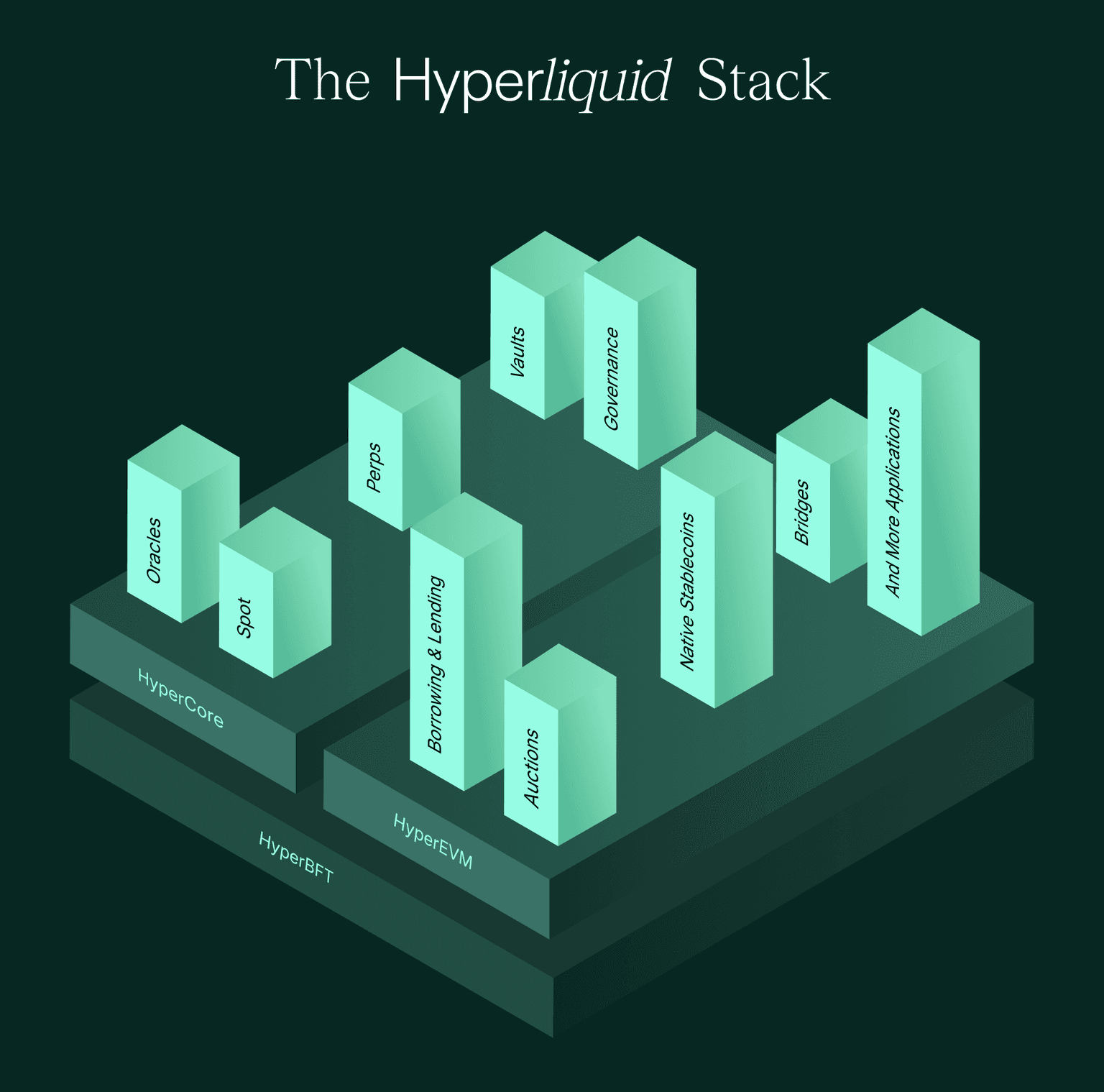
While distinct environments, HyperCore and HyperEVM still share the same state and run atop HyperBFT (Hyperliquid’s consensus mechanism). That way, developers can still make use of the throughput HyperCore provides.
Now, distinct development surfaces also mean that you can’t use a HyperCore RPC to build on HyperEVM. HyperCore does not use standard Ethereum JSON RPC methods, so it doesn’t work out of the box with the EVM stack. HyperEVM, however, neatly integrates with all libraries Solidity developers are accustomed to.
This guide analyzes 8 HyperEVM and Hyperliquid RPC providers. We will compare the leading public and enterprise options available today so you know where to build your next billion-dollar idea.
Understanding Hyperliquid RPC infrastructure in 2026
An RPC (Remote Procedure Call) is what connects your application to Hyperliquid and makes it usable. Hyperliquid’s unique architecture splits RPC infrastructure into two.
HyperCore, Hyperliquid’s trading engine, requires bespoke infrastructure to build on it. HyperEVM, however, supports familiar JSON RPC methods so that developers can deploy Solidity smart contracts as they normally would and Alchemy can support it with standard endpoints.
When should you choose Hyperliquid RPC vs. HyperEVM RPC?
HyperCore is the native non-EVM environment of Hyperliquid. It is purpose-built to handle fast and scalable DEX activity directly onchain. It makes up the core trading layer of Hyperliquid and sits alongside HyperEVM.
A HyperCore RPC is the right choice if you’re building trading interfaces, market data tools, or anything pertaining to Hyperliquid’s economic activity and requiring extremely high performance.
HyperEVM is the general-purpose EVM-compatible environment where you can deploy smart contracts. Solidity developers will find this environment extremely familiar.
A HyperEVM RPC is the right choice if you want to deploy Solidity smart contracts or if you’re building applications like credit markets, bridges, or any composable app.
The depth and quality of support vary widely across providers (and the different pricing tiers within each provider), which is why you must research thoroughly before choosing an infrastructure partner for your Hyperliquid project.
Public vs private RPC endpoints
Since developers building for the Hyperliquid ecosystem are working in different execution environments, the choice between public and private RPC endpoints matters more than in other ecosystems, say, Solana.
Also Read: Top Solana RPC Providers
Public RPC endpoints are great for beginners or for developers who need a make-do sandbox environment. While convenient and easily accessible, their performance tends to be unreliable and subject to rate limits.
The Hyperliquid core team provides a public RPC endpoint for HyperEVM, but it’s very limited. The official endpoints are:
- Mainnet:
https://rpc.hyperliquid.xyz/evm(Chain ID 999) - Testnet:
https://rpc.hyperliquid-testnet.xyz/evm(Chain ID 998)
As of January 2026, Hyperliquid’s public RPC allows a maximum of 100 EVM JSON-RPC requests per minute. This is sufficient for light work like testing and prototyping.
A private RPC endpoint can overcome all the limitations of a public RPC endpoint. In a private environment, you get dedicated resources for bringing your next big idea to fruition.
If you want to move beyond experimentation with a private endpoint, we provide production-ready HyperEVM RPC endpoints with a 15x greater throughput (25 rps) than Hyperliquid’s public endpoint.
- RPC:
https://hyperliquid-mainnet.g.alchemy.com/v2/<api-key> - WebSocket:
wss://hyperliquid-mainnet.g.alchemy.com/v2/<api-key>
Get started here: https://www.alchemy.com/rpc/hyperliquid
Comparing 8 best Hyperliquid RPC providers for 2026
The only public Hyperliquid (HyperEVM) RPC is provided by the Hyperliquid core team and is closed source. Any other Hyperliquid RPC you may come across (that are not mentioned in this guide) are private.
Below is a comparison of the leading RPC providers for Hyperliquid. Every private RPC provider mentioned in the list provides WebSocket support and ‘Read Access’ to HyperCore data via HypereEVM endpoints.
Also Read: What is an RPC Node?
As you go through the list please note that most providers focus on the HyperEVM RPC. When we say a provider “supports Hyperliquid,” we generally mean they provide HyperEVM JSON-RPC endpoints (for mainnet and often testnet).
Only a few providers also expose HyperCore-specific data (e.g. order book feeds via gRPC or special APIs). We will note those cases. Otherwise, assume that these services let you interact with Hyperliquid via the HyperEVM interface (which is sufficient for most app development).
1. Official Hyperliquid RPC (public node)
Hyperliquid offers a free HyperEVM RPC endpoint to build applications. While limited in features, the ease of access (free and no sign up requirement) make it a good option to start testing the waters.
Key features
- Anyone can use the endpoint without signing up or paying
- The endpoint is maintained by the Hyperliquid team
Limitations of the public Hyperliquid RPC
- Rate limited to 100 requests/minute per IP
- Does not support WebSocket (only for HyperEVM; exchange API supports WebSocket)
- Intended for light testing and prototyping and not for production-ready apps
- Developers must move to private providers for increased throughput
Cost of public Hyperliquid RPC
- Hyperliquid’s public RPC is free
- There are no tiers or upgrade options
2. Alchemy: world’s leading developer infra provider
Alchemy brings polished tooling, stable performance, and multi-chain convenience, all under one API key. For Hyperliquid specifically, Alchemy focuses on HyperEVM rather than HyperCore and provides developers all the tools they need to build on Hyperliquid under one roof.
We are one of the few providers to offer a very generous free tier that suits even production-grade small-to-mid size applications on Hyperliquid.
Key features of Alchemy HyperEVM RPC
- Provides developer-first tooling and priority support right for paying customers (and standard support for free tier)
- Up to 30 million compute units (CUs) per month in the free tier
- Unmatched reliability with ~99.9% uptime
- Advanced analytics dashboard gives metrics on requests, error rates, latency, and more
- Flexible tiers and generous free plan makes Alchemy ideal for high-growth teams
- Pay-as-you-go pricing model unlocks access to features and toolings that are normally paywalled behind bigger tiers by other providers
Limitations of Alchemy HyperEVM RPC
- Some features like the Debug API and Trace API are not available on the free tier
- Pricing is based on Compute Units (CUs), which can make one-to-one cost translation for HyperEVM requests tricky
Cost of Alchemy HyperEVM RPC
- Free tier: Permanent free tier that can support small production apps.
- Cheapest entry: Pay-as-you-go pricing starting at $5.
- Enterprise: Custom SLAs, higher throughput, archive access, priority support, and volume discounts.
3. QuickNode
Quicknode is a well-established fast-growing RPC infrastructure provider. In 2025, the company began offering the HyperEVM RPC endpoint (it does not offer HyperCore RPC).
The provider offers a 1 month free trial as opposed to Alchemy that offers a permanent free tier with higher limits. Prices for Quicknode start at $49/mo after the trial period and the highest plan (not Enterprise) is at $999/mo.
Key features of QuickNode HyperEVM RPC
- Focuses on lowering latency with global network of nodes and automatic geographic load balancing
- No new dashboards or API keys needed if already using Quicknode RPC for other networks
- Provides dual endpoint paths (/evm and /nanoreth)
Limitations of QuickNode HyperEVM RPC
- You only get WSS on /nanoreth, and responses are capped
- Rate limits are lower for debug and trace methods
- Does not offer a permanent free tier (only free trial)
Cost of QuickNode HyperEVM RPC
- Free tier: 1 month free trial only (with specific limits).
- Cheapest entry: Mid-range pricing compared to competitors. Starts at $49/mo.
- Enterprise: Custom RPS limits, private infrastructure, and enterprise support at higher tiers.
4. Chainstack
Chainstack is one of the few private Hyperliquid RPC providers to offer both HyperEVM and HyperCore RPC endpoints. The provider also offers ‘Yellowstone Geyser gRPC’ and ‘Unlimited Nodes’ as add-ons, making the economics slightly more flexible.
Key features of chainstack Hyperliquid RPC
- Provides WebSocket support for real-time event streaming and subscriptions similar to Alchemy
- Both HyperEVM and HyperCore RPC endpoints are available
- One unified dashboard to manage HyperEVM and HyperCore environments
Limitations of chainstack Hyperliquid RPC
- Traffic spikes require proactive resizing or adding nodes
- No advanced developer tools like transaction simulation
- Archive data is paywalled behind higher tiers
Cost of chainstack Hyperliquid RPC
- Free tier: Small but usable free tier for testing and development.
- Cheapest entry: Affordable entry-level plans, competitive with other mid-market providers. Starts at $49/mo (or $480/yr).
- Enterprise: Dedicated nodes, priority support, and HyperCore access with higher spend.
5. dRPC
dRPC is a relatively new entrant among Hyperliquid RPC providers. It provides only HyperEVM RPC endpoints and focuses on simplicity rather than feature overloads. Pricing is heavily dependent on Computer Units, or CUs (learn more about dRPC CUs here).
Key features of dRPC HyperEVM RPC
- Geo-distributed node clusters reduce latency
- AI-driven load balancing that route around slow or unhealthy upstream nodes
- Public-node aggregation (load-balancing over multiple public nodes) even on the free tier
Limitations of dRPC HyperEVM RPC
- Lacks developer tools like webhooks and debugging dashboards
- No dedicated support team (only community support)
- Free tier is suited only for testing or prototyping
Cost of dRPC HyperEVM RPC
- Free tier: Generous free tier, but mainly suited for testing and experimentation.
- Cheapest entry: Low-cost paid plans compared to most providers. Starts at $6 with specific limits.
- Enterprise: High-throughput plans with custom limits, but limited enterprise tooling.
6. HypeRPC
HypeRPC is a Hyperliquid-only RPC provider, i.e., it does support any other blockchain. Builders get 5% off on quarterly subscriptions, 10% off on biannual subscriptions, and 20% off on annual subscriptions.
Key features of HypeRPC HyperEVM RPC
- Offers both shared and dedicated nodes
- Claims 99.99% uptime and ultra-low latency in the highest tier
- WebSocket access and archive data come right from the free tier
Limitations of HypeRPC HyperEVM RPC
- Supports regional routing only in EU and JP with a 50% surcharged for the latter
- Does not offer heavy dev tools like deep analytics dashboards and transaction simulation
- Lack of enterprise-level features like multi-region failover
- 99.99% uptime is guaranteed only for the highest tier (Dedicated), unlike Alchemy that offers 99.9% uptime even on the free tier
Cost of HypeRPC HyperEVM RPC
- Free tier: Includes WebSocket and archive access, uncommon among free tiers.
- Cheapest entry: Slightly higher compared to other RPC providers in the niche. Starts at $99/mo.
- Enterprise: Dedicated nodes and higher uptime guarantees at premium tiers.
7. Dwellir
Dwellir is reputed for its stable, reliable, and low latency infrastructure of high quality, globally distributed RPC nodes. In addition to the regular pricing tiers, $1150/mo gets you unlimited RPS and responses, access to engineering teams, dedicated account manager, and more
It offers managed Hyperliquid infrastructure with two tracks:
- Shared HyperEVM RPC endpoints for typical EVM app traffic, and
- A more “Hyperliquid-native” path via custom gRPC streaming for Layer-1 data (order books, fills, market info), plus dedicated nodes for teams that need isolated capacity.
Key features of dwellir Hyperliquid RPC
- Offers the most simple, predictable billing with 1 RPC = 1 API credit (including Trace and Debug APIs)
- Custom gRPC streaming interface for Hyperliquid Layer 1 data
- Each user gets their own isolated managed node
Limitations of dwellir Hyperliquid RPC
- Focuses on infrastructure, not tooling (so no simulator, debugging suite, or real-time analytics dashboard)
- Lacks advanced developer tools
- Apps requiring high throughput would need dedicated nodes, which is a big step-up in pricing at $1,150/mo
Cost of dwellir Hyperliquid RPC
- Free tier: Unavailable.
- Cheapest entry: Starter tier is $5 (one-time payment). Suitable only for testing or dog-fooding. Usable plants start at $49/mo, which is mid-range compared to other providers.
- Enterprise: Dedicated nodes, custom gRPC streams, and direct engineering support.
8. OnFinality
OnFinality launched Hyperliquid support in the third quarter of 2025 and offers Hyperliquid API endpoints based in Hong Kong, North Virginia, and France. Pricing is based on Response Units (RUs).
Key features of OnFinality HyperEVM RPC
- Claims 99.99% uptime for RPCs
- All OnFinality plans include access to full archive data
- OnFinality also supports one-click-deploy dedicated nodes
Limitations of OnFinality HyperEVM RPC
- OnFinality bills in API response units, and different workloads can burn units at different rates, so predictability is difficult
- No advanced developer diagnostics like transaction simulation or built-in debugging tools
- Shared plans tend to hit ceilings earlier for bursty traffic
Cost of OnFinality HyperEVM RPC
- Free tier: Limited free tier suitable only for light usage.
- Cheapest entry: Comparable to other mid-market RPC providers. Starts at $49/mo.
- Enterprise: Fully customizable plans with dedicated nodes and global deployment options.
Verdict: Alchemy is the most complete Hyperliquid RPC provider
Each infrastructure provider mentioned in this article excels in a specific area Alchemy is the only one that covers performance, developer experience, and production readiness in a single offering.
Alchemy provides a real-time analytics dashboard from the free tier, including request volume, error rates, and method-level breakdowns.
As teams scale, Alchemy offers archive reads on paid plans without forcing a dedicated node deployment along with built-in global routing and failover.
The bottom line is that Alchemy is the only provider in this list that consistently offers analytics, debugging, WebSockets, archive access, and global reliability earlier in the lifecycle, with a smoother path from free experimentation to production scale.
FAQs
What's the best Hyperliquid RPC provider for most applications?
For most applications, Alchemy is the best Hyperliquid RPC provider. You get reliable HyperEVM RPC access, strong global performance, and the most complete developer tooling. If you’re new, get started with the most generous free tier for Hyperliquid RPC in the market.
Is HyperEVM safe?
Yes. All HyperEVM blocks and transactions are finalized by the same HyperBFT consensus, so HyperEVM inherits full security from the Hyperliquid network.
Why is WebSocket support important for a Hyperliquid RPC?
WebSocket support is important because it enables real-time data updates. With WebSockets, applications can subscribe to events like new blocks, logs, and contract events without constantly polling the RPC. On Hyperliquid, this is especially useful for trading interfaces, monitoring tools, and bots that need immediate updates.
Why do I need more than one node from an RPC provider?
Using multiple nodes improves reliability and uptime. Alchemy provides endpoints backed by its distributed Cortex engine, so you get multi-node redundancy, load balancing, and failover without managing multiple nodes yourself.
What are ‘requests per second’ in Hyperliquid RPC?
Requests per second (RPS), in Hyperliquid or otherwise, measures how many RPC calls your application can make each second.
Higher RPS limits allow faster data ingestion and smoother real-time applications. Low RPS limits can cause throttling, delayed responses, or failed requests during traffic spikes.
Can I migrate to Alchemy from another provider without code changes?
Yes. In most cases, you can migrate to Alchemy by simply changing the RPC endpoint URL. Alchemy RPC supports standard Ethereum JSON-RPC for HyperEVM, so existing code built with Ethers.js, Web3.js, Hardhat, Foundry, wallets, or backend services continues to work without modification. The only change required is updating the endpoint and adding an API key if needed.
Related Overviews
 Infra
InfraOctober 13, 2026
What is a blockchain indexer?
How a blockchain indexer reads blocks, survives reorgs, and when to build one versus call a managed API.
 Infra
InfraOctober 13, 2026
Google Cloud Blockchain Node Engine alternative: how to switch to Alchemy
Google Cloud Blockchain Node Engine shuts down December 15, 2026. Switch to Alchemy with a URL change, keep your code, and get 100+ chains on one key.
 Infra
InfraSeptember 10, 2026
Best blockchain APIs for building autonomous onchain agents
A comparison of the top blockchain API providers for autonomous onchain agents, covering agent-native features, chain coverage, and the capabilities that matter when your user is a machine.

Build blockchain magic
Alchemy combines the most powerful web3 developer products and tools with resources, community and legendary support.