How Alchemy powers financial services onchain
Author: Alchemy
A financial app is judged in milliseconds.
When someone checks a savings balance, submits a trade, waits on a deposit to clear, or watches a loan position during a volatile hour, a stale answer costs the same as a wrong one. The chain underneath is decentralized. The product on top gets held to the standard customers already know from every other financial app they use.
Finance is moving onchain, and the infrastructure question moves with it. Across lending, exchanges, stablecoin accounts, remittances, portfolio tools, and market data, we provide the connection between a financial product and the chain: low-latency reads, reliable transaction execution, real-time event delivery, archival data for history, and single-tenant dedicated capacity for teams that need their own. We also publish a live latency benchmark of our EVM endpoints against QuickNode, dRPC, and Infura, with the methodology and the raw data open, so the performance claim is something you can check rather than something you have to accept.
Why does infrastructure decide whether a financial product works?
Every onchain financial product runs a loop between a user action and a chain response, and the loop has a deadline.
A lender must know the current value of collateral before it can calculate a borrower's health factor. An exchange needs independent confirmation that a deposit settled before it credits a customer. A payments app has to submit a stablecoin transfer, track it, and show the new balance without making the customer learn what gas is. A market data provider has to publish a price fast enough for the protocols reading it.
Break any part of that loop and the failure shows up as a product failure, not an infrastructure one. A missed trade. A deposit that sits there. A balance that is quietly wrong. Customers do not file it under "RPC degradation."
That is why teams like Aave, Bitget, Pana, Polymarket, RedStone, Symphony, Solflare, 0x, Zapper, and Zerion treat latency and reliability as product requirements rather than vendor line items.
How does RPC latency affect transaction execution and trading performance?
RPC latency sets the floor on how quickly a financial product can read state and get a transaction submitted, so it shows up directly in quote freshness, deposit crediting time, and whether a trade lands at the price the user saw. An RPC endpoint is the interface an application calls to read blockchain state and submit transactions. Every millisecond it adds is a millisecond the user waits, and under volatility that delay is where slippage and stale prices come from.
The fastest request is not always the one sent to the nearest machine. Node health changes minute to minute. Traffic patterns shift. A heavy historical query and a simple balance check have different infrastructure needs and should not compete for the same capacity.
Cortex is the engine underneath our platform that handles this. It routes each request to capacity that is currently healthy and suited to that specific method, and it adapts as conditions change instead of following a fixed map. The published gains over our prior architecture are 2.5x faster, 5x more reliable, and 500x more throughput.
For a financial product, that work happens before a user feels anything. Quote screens stay responsive through a burst of trading. A team's historical data rebuild runs without slowing the live queries their customers depend on. When one path degrades, requests move off it before customers notice.
Aave runs the largest lending protocol in DeFi across more than 20 networks, where lending never pauses and stale state means a user misreads their own position. After moving to Cortex, Aave's indexing and backfill workloads ran 3 to 5 times faster. When the Aave API spiked above roughly 70,000 requests per second, we absorbed it without incident.
What makes blockchain infrastructure reliable enough for financial services?
Reliability for a financial workload means two things at once: the request succeeds, and the answer it returns is complete and correct. A fast wrong answer is worse than a slow one.
We deliver that across multi-chain RPC for reads and writes, archival data for historical queries, and real-time event systems for activity as it settles. Teams can also observe and investigate their own blockchain traffic, which is how most problems get caught before a customer reports one.
Bitget serves more than 125 million users and uses us as an independent confirmation layer for deposits and withdrawals. Its own nodes carry most of the workload. We sit alongside them as a second, unaffiliated source of truth for anything touching customer funds, so a bug or a lag in one system cannot silently credit or debit an account. Over a recent 30-day window, Bitget routed more than 25 million requests across 9 networks to us with zero errors.
That design is worth copying. Any single provider, including us, is a single point of failure for a product that moves money. Bitget's answer is to run its own nodes and keep a second independent path for the workflows where being wrong is expensive.
For RedStone, reliability is market integrity. RedStone supplies price feeds to lending markets, perpetuals, stablecoins, FX pairs, and tokenized real-world assets, and it made us its preferred RPC provider for new chain launches in February 2025. Since then we have served more than 12 billion requests, with 51 chains actively running RedStone traffic on our nodes today. Its lifetime price-push record is 26.8 million onchain transactions at a 99.999% success rate. For a feed that liquidation engines read, that success rate is the difference between a market that clears correctly and one that does not.
How do you keep a product in sync with the chain in real time?
The reliable way to stay in sync is to have the chain push events to you rather than polling it, which is what a webhook does: an HTTP callback fired at your service the moment a matching onchain event occurs. Polling many chains on a timer means either paying for constant queries or accepting a lag, and it means building and running that polling infrastructure yourself.
Alchemy Webhooks covers that. Teams subscribe to the events they care about and keep their own ledgers, notifications, and interfaces current as activity lands. Delivery is at-least-once, so a transient failure on your side does not turn into a lost event.
Slingshot had built cross-chain deposit tracking across 40 separate Google Cloud services, with one system for EVM chains and another for Solana. Replacing it with Webhooks took about 20 lines of code and one week. The result was a single real-time deposit system with zero missed deposits.
How do you load historical activity without making the user wait?
Live events keep a ledger current. History is what a customer sees when they open the app: past transfers, portfolio analytics, years of activity. That has to load as fast as a live balance.
Solflare uses our Solana Archive Method to serve historical activity and portfolio analytics to more than 4 million active users. Archive queries run up to 20 times faster than other providers Solflare tested, with sub-200ms response times, which is why a user can open the app and see their full financial history load rather than watch a spinner.
How do you remove blockchain friction from a financial product?
The customer-facing goal is that nothing about the chain reaches the customer. They should make a payment without first buying a native token, fund an account through a signing flow they understand, and complete a savings action without touching network settings.
Programmable accounts are wallets that can hold their own rules, so an app can move funds and enforce spend limits at the account level instead of pushing every mechanic onto the user. Gas sponsorship lets the app pay network fees on the customer's behalf and get billed in dollars. Together with reliable transaction submission and real-time status updates, teams design the flow they want while settlement still happens onchain.
That layer now carries about 85% of gasless transactions across EVM and Solana, at 99.99% uptime with sub-50ms responses.
Pana uses our RPC and gas sponsorship for stablecoin remittances, card funding, and settlement on Base and Ethereum. It reached more than 200,000 users in under six months and processes tens of thousands of stablecoin transactions a day.
Symphony has processed more than $500 million in transaction volume and runs across six networks. Over a recent 30-day window we served more than 800,000 requests for Symphony at a 100% success rate across every correctly configured mainnet.
Which financial teams build on Alchemy, and what have they measured?
How should you evaluate an infrastructure provider for financial workloads?
Ask for numbers you can reproduce, then reproduce them on your own traffic. Vendor marketing is not a benchmark and neither is a single screenshot.
Four things are worth checking before you sign anything.
Latency on your methods, in your regions
Aggregate averages hide the slow calls that matter. Test the specific methods your product depends on, from the regions your users are in, and look at p95 rather than the mean. Our benchmark methodology documents how we run ours, including the regions, the timeout rules, and what counts as a failure, so you can replicate the setup against any provider.
Success rate under load, not at rest
A provider that is fast at baseline and drops requests during a volatility spike is not usable for finance. Load-test at the peak you expect, then double it.
Failure behavior
What happens when a node degrades, and how fast does traffic move off it? Check the provider's status page and incident history before you check its homepage.
Isolation, when you need it
Shared endpoints put your traffic alongside everyone else's. Dedicated Clusters are single-tenant, SOC 2 Type II compliant, and deployable in the region closest to your users or your matching engine. Switchover onto shared RPC capacity is optional, and it covers traffic above the cluster's capacity. That matters most for trading systems and any workload where a noisy neighbor is an unacceptable variable.
Build for the financial system moving onchain
The financial teams building with us are solving different problems. Some are widening access to credit. Some are making cross-border payments cheaper. Some are delivering market data, trading tools, custody, or portfolio intelligence.
What connects them is the standard their own customers hold them to: fast answers, transactions that land, and a product worthy of handling money. As more settlement, trading, and investment moves onchain, that standard passes straight through to the infrastructure underneath, because what a customer experiences as a confirmed payment or an accurate balance is, underneath, whether the chain connection held.
We give teams one foundation for low-latency blockchain access, resilient transaction infrastructure, real-time data, dedicated single-tenant capacity, and customer-ready execution flows, across every chain they expand to.
Aave has run its lending traffic on us since 2021, through every network expansion and every record deposit day, and its users have never had to know we exist. That is the job.
Build financial products on Alchemy.
Frequently asked questions
Is Alchemy reliable, and what is its uptime track record?
Alchemy publishes 99.995% uptime while securing more than $1 trillion in annual transaction volume, and keeps incident history public on its status page. Customer-verified evidence includes Bitget's 25 million requests across 9 networks with zero errors and RedStone's 99.999% price-push success rate.
What is Alchemy Cortex?
Cortex is the intelligent blockchain engine that powers the Alchemy developer platform. It routes each request to healthy capacity suited to that specific method and adapts as node health and traffic shift, rather than following static routing. Alchemy publishes the result as 2.5x faster, 5x more reliable, and 500x more throughput than the prior architecture.
How does RPC latency affect transaction execution and trading performance?
RPC latency sets the floor on how fast an application can read chain state and submit a transaction. Higher latency means quotes go stale, deposits credit late, and trades land at worse prices than the user saw. For trading systems, p95 latency in your own region matters more than a global average.
What SLA should I expect from an enterprise RPC provider?
Signed SLAs come with Alchemy's Enterprise plans, with uptime and response commitments negotiated per contract rather than published as one public figure. From any provider, ask for four things: the uptime number, the measurement window, the exclusions, and the remedy when it is missed. A percentage without those is not an SLA.
What are the risks of relying on a single RPC provider in production?
A single provider is a single point of failure for anything that moves money. Bitget's approach is a good model: run your own nodes for the bulk of traffic and keep a second, independent provider as a separate source of truth for deposits, withdrawals, and any workflow where a wrong answer is expensive.
Which blockchain API offers the most reliable webhook delivery?
Alchemy Webhooks guarantee at-least-once delivery, so a transient failure on your side does not become a lost event. Slingshot replaced cross-chain deposit tracking that spanned 40 Google Cloud services with roughly 20 lines of code and reported zero missed deposits across EVM chains and Solana.
How do I benchmark RPC providers before choosing one?
Test the specific methods your product calls, from the regions your users are in, on standard paid accounts, with no retries and a fixed timeout. Report p95 alongside the average, and separate success rate from latency. Alchemy's benchmark methodology documents a setup you can replicate against any provider.
Alchemy or QuickNode for high-volume stablecoin payment infrastructure?
Both run production stablecoin workloads at scale. The useful comparison is measured latency on your methods, success rate at your peak, and whether transaction submission and gas sponsorship come from the same provider as your reads. Alchemy's live benchmark publishes its numbers against QuickNode with open methodology and raw data.
Which provider offers single-tenant dedicated nodes with regional deployment?
Alchemy Dedicated Clusters are single-tenant and SOC 2 Type II compliant, with no shared traffic or compute. They deploy in the region closest to your stack or your users for lower latency. Switchover onto shared RPC capacity is optional, and it covers traffic above the cluster's capacity.
Alchemy Newsletter
Be the first to know about releases
Sign up for our newsletter
Get the latest product updates and resources from Alchemy
By entering your email address, you agree to receive our marketing communications and product updates. You acknowledge that Alchemy processes the information we receive in accordance with our Privacy Notice. You can unsubscribe anytime.

Related articles
Architecting Solana RPC reads for industry-leading speed and reliability
Alchemy has the lowest Solana read latency: 9.21 ms, about 26% faster than the next provider.
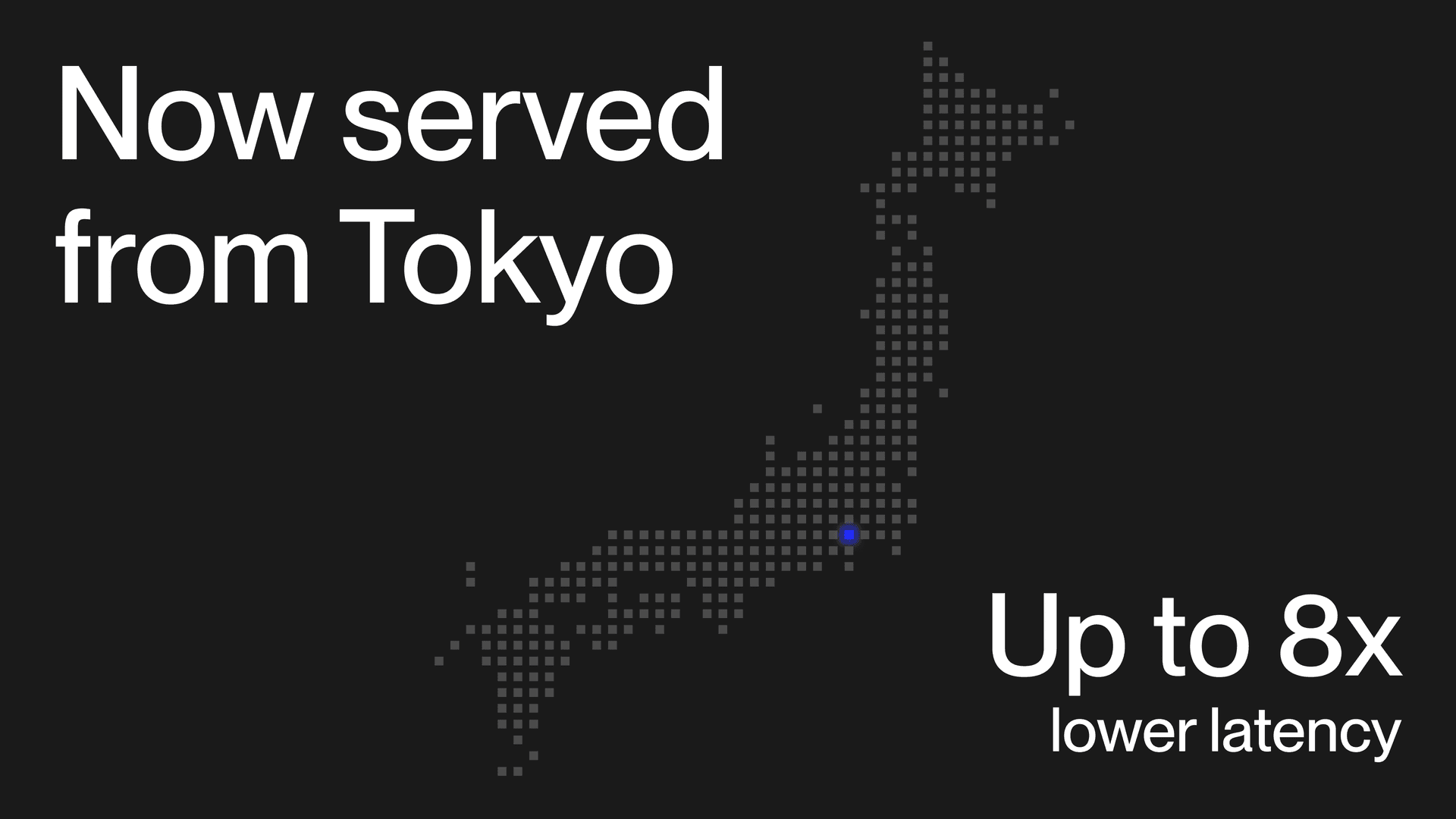
Alchemy launches Tokyo regional support
Node RPC, WebSockets, and Dedicated Clusters are now live in Tokyo, with up to 8x lower median latency for requests from Japan.
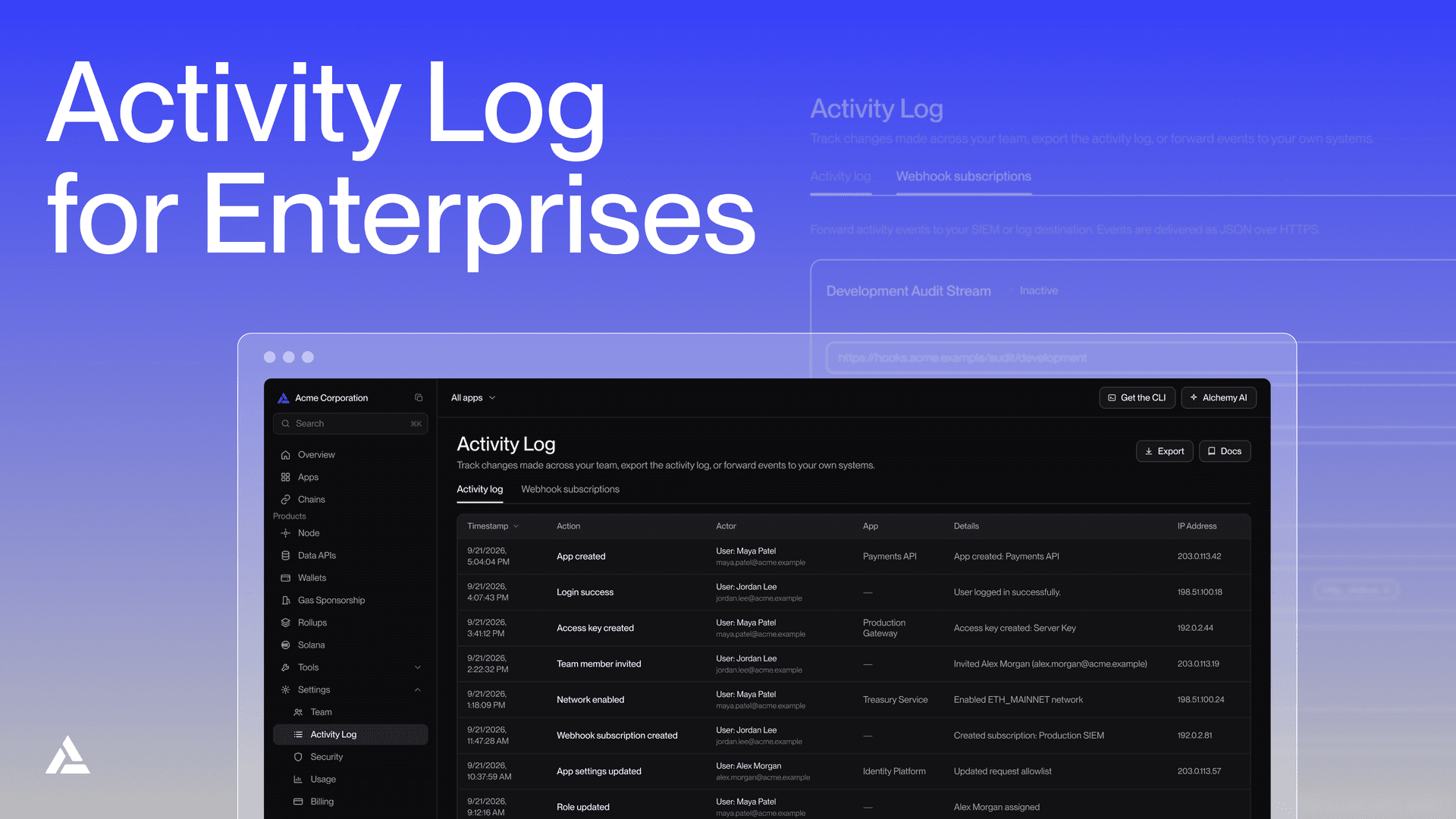
Introducing Activity Log for Enterprises
Activity Log is now available for enterprise teams. Review account changes in the dashboard, or send them to your SIEM.