
JPool
JPool is a Solana liquid staking platform where users stake SOL, receive JSOL, and earn up to 10% APY.


What is JPool?
JPool is a Solana liquid staking platform based in Switzerland that lets users stake SOL and receive the JSOL token, which represents their ownership in the pool and grows as it accrues staking rewards. JSOL can also be used as a DeFi instrument for liquidity mining, with up to 15% APY potential. JPool offers four staking strategies: Direct Staking for manual validator selection, Leveraged Direct Staking to multiply rewards via flash-loan-based leverage, Liquid Staking for hands-off yield optimization across 2,500+ validators, and the Holders Club for earning boosted rewards through quests and partner DeFi protocols. JPool also provides auxiliary services including an analytics dashboard for validator operators and delegators, a Validator Toolkit for bootstrapping and maintaining Solana validator nodes, and a Bookkeeper for financial and fiscal reporting.
Web3 dapps and developer tools related to JPool
Discover blockchain applications that are frequently used with JPool.
 Glow Finance
 Lista DAO

 Suilend Protocol
 BitFi
BitFi

Developer resources from Alchemy
Autonomous onchain actions: what AI agents can actually do onchain
Onchain agents are AI that hold a wallet and use it. Six action primitives, real production agents, and the payment stack behind autonomous onchain actions.

Alchemy Validators expands Solana staking rewards with Pye Labs
Alchemy collaborates with Pye Labs for institutional Solana staking with 13-25% yields vs 7%. Features programmable lockups, transparent terms, tradeable positions, and 99.9%+ uptime across institutional-grade infrastructure.
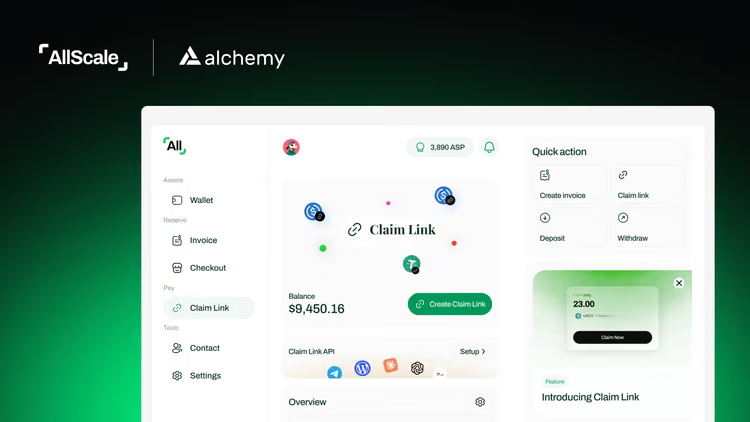
How AllScale powers fast, reliable stablecoin payments at scale
AllScale standardized blockchain reads and transaction requests on Alchemy Node API to power stablecoin checkout, invoicing, payroll, and payouts.
JPool alternatives
Explore web3 competitors and apps like JPool.
 ether.fi

 Crypto.com Liquid Staking

 PumpBTC
 Obol
ObolApp store listings are independently reviewed and written by Alchemy using a combination of inbound submissions, editorial research, public project sources, and third-party directories, including ecosystem data from The Grid under the Open Database License, DefiLlama, DappRadar, Reown, and chain ecosystem pages.