How Metric keeps its pools quoting against a live market
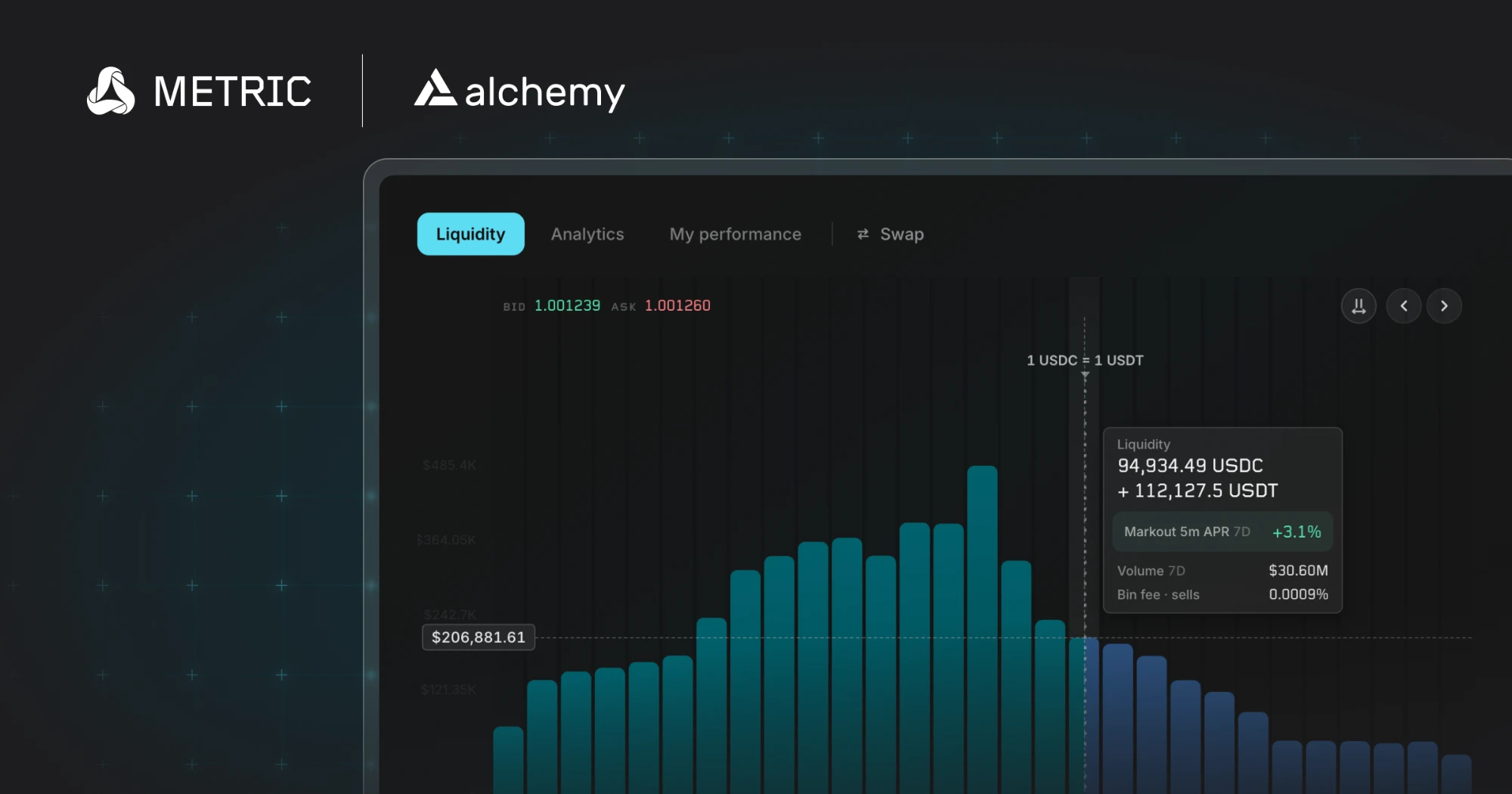
Metric.xyz built a decentralized exchange where liquidity follows the market instead of waiting for it. Most exchanges run on an automated market maker, or AMM, which holds liquidity at fixed prices until arbitrage traders drag it back toward reality. Metric's pools quote actively against a live reference price, so liquidity sits where the asset is trading. That design depends on a demanding promise behind the scenes: the reference price behind every pool has to stay current with the market, continuously.
Alchemy is the data layer behind that promise. Alchemy Node RPC and Alchemy Websockets give Metric a continuous, low-latency stream of onchain state, served from dedicated clusters in Tokyo to keep the path close to Metric's own systems. That feed is what Metric's pricing service turns into the reference prices its pools quote against, at a cost that lets it run at full rate.
Products used: Alchemy Node RPC, Alchemy Websockets
The challenge: a quoting pool needs data that doesn't stop
Metric is built for reference-priced assets: tokenized equities, bonds, yield-bearing real-world assets, and crypto majors. These are instruments whose price lives off the exchange and keeps moving whether or not the pool is paying attention.
That creates a dependency a passive AMM doesn't have. A pool quoting against a live price needs that price continuously, which makes the data feed load-bearing rather than convenient. Metric's infrastructure pulls a continuous stream of onchain data and turns it into the reference prices its pools quote against, and both sides of the business depend on it: traders and liquidity providers work with the pools directly, and other teams build on top of Metric's infrastructure.
When that stream degrades, Metric's fallback absorbs the gap and every request still gets served. When it degrades far enough, the fallback runs out of room. Metric's API goes down, which risks stopping oracle updates landing. An oracle update that doesn't land leaves a pool quoting a price the market has already moved past. For an exchange built on the premise that liquidity follows the market, that undoes the whole design.
The solution: a feed Metric can afford to run at full rate
Selected on speed and cost, measured head to head
Metric didn't run a procurement process. They ran a test. The team tried several providers and compared the two things that mattered for this workload: how fast the data arrived, and what it cost. Features weren't the deciding factor. Speed and cost were.
Those two are more connected than they look. Every requote costs a read, so at Metric's volume the cost of data decides how often the pools can afford to refresh, and that decides how closely liquidity tracks the market. Metric needed an RPC layer fast enough to quote against and cheap enough to do it continuously. On Metric's own testing, we came out competitive on latency and affordable enough to run the feed at full rate.
A continuous feed behind every reference price
Alchemy Node RPC and Alchemy Websockets provide the onchain state behind Metric's reference prices, served from dedicated nodes in Tokyo so the serving path stays close to Metric's own systems. Metric reads chain state continuously rather than sampling it, which is what lets its pools quote against the market rather than against a recent snapshot of it.
Best-in-class support
When Metric hit a question during the migration, they had an answer the same day rather than a ticket number.
"We tested several providers and compared them on the two things that matter to us: how fast the data arrives and what it costs. Alchemy gave us the data we need, reliably, and the economics work at the volume we run. I have worked with Alchemy before, and seeing them deliver again to the same quality was both impressive and consistent. We get answers quickly, from people who understand what we're building."
— Christos G, Chief Technical Officer, Metric
The results: liquidity that tracks the market, continuously
For a trader, the result is that Metric's pools quote close to where the asset is actually trading, which is the whole point of the architecture. For a liquidity provider, it means less value lost to the arbitrage that corrects a stale pool.
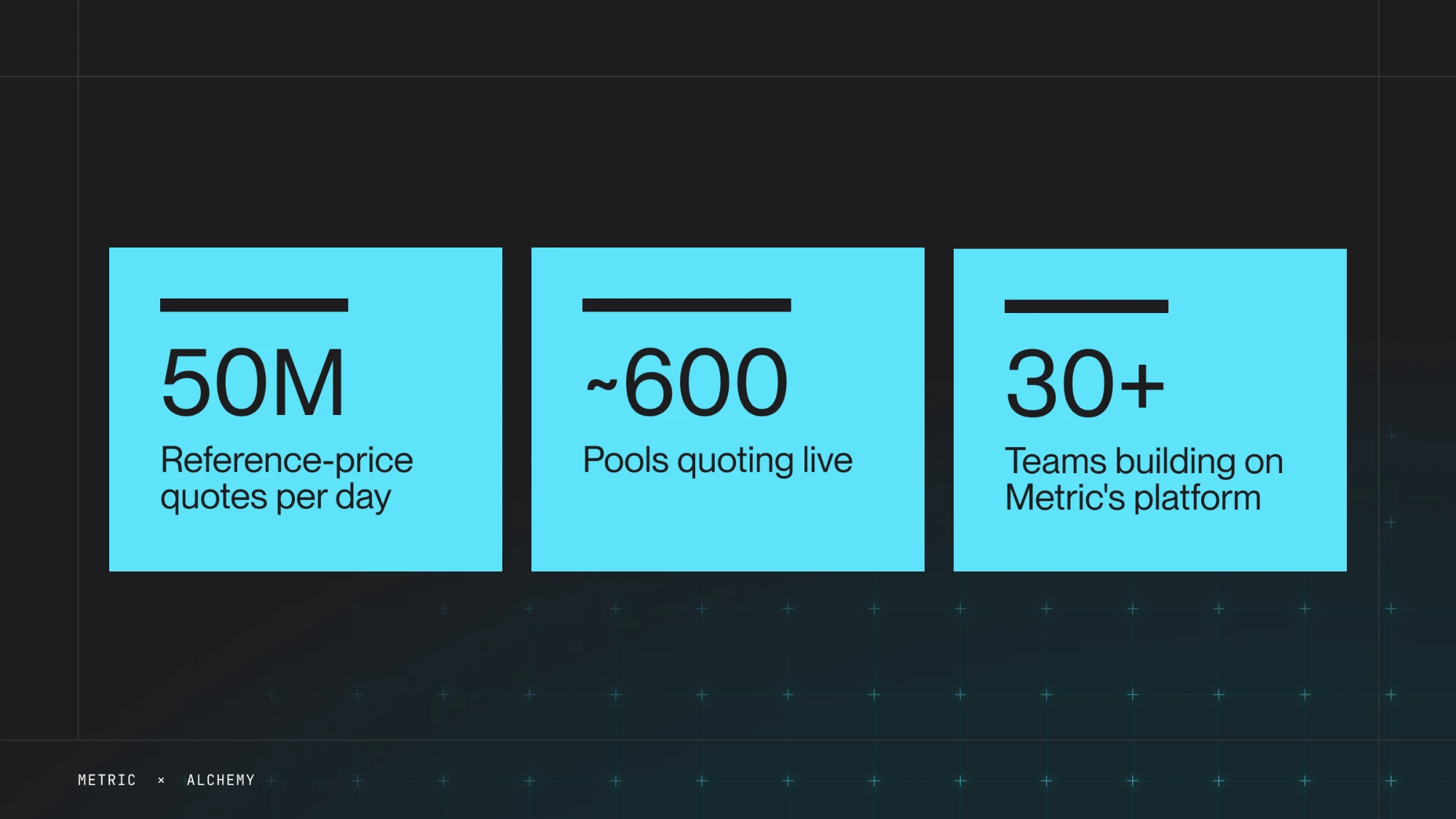
For the platform, those quotes rest on a feed running without interruption: Alchemy serves 50M reference-price quotes per day across Metric's pools, at a cost that lets Metric refresh as often as the design calls for rather than as often as the budget allows.
Reliability is the standard here, not a feature request. The feed sits directly on the path between the market and every quote Metric publishes.
What's next
Traders can swap, teams can deploy pools through Metric's infrastructure, and liquidity providers can supply public pools. Every pool that goes live is another price to quote against, continuously, and Metric's roadmap reflects that with more dedicated node capacity as the platform grows.
Build live-quoting infrastructure with Alchemy
When your pools quote against the market in real time, the speed and the cost of chain data decide how closely you can track it.
Related case studies
 DeFi
October 27, 2026
How Route keeps swaps fast and reliable on Robinhood Chain
Route prices every swap across 2.4 million+ pools on Robinhood Chain. With Alchemy Node RPC behind its router, over 99% of quotes succeed.
 DeFi
October 13, 2026
How Cash App makes stablecoin money movement feel as simple as cash
Cash App uses Alchemy Node APIs and Webhooks so every stablecoin balance and transfer stays continuously verifiable against public chain state.
 DeFi
September 15, 2026
How AllScale powers fast, reliable stablecoin payments at scale
AllScale standardized blockchain reads and transaction requests on Alchemy Node API to power stablecoin checkout, invoicing, payroll, and payouts.

Build blockchain magic
Alchemy combines the most powerful web3 developer products and tools with resources, community and legendary support.