How Valantis built a reliable trading experience on Hyperliquid
When a trader cannot open or close a DCA position, an infrastructure incident becomes a product incident.
Valantis builds Earn and Trading products on Hyperliquid, including stHYPE, its liquid staking token, and Prime, a trading account system that brings stHYPE utility to HyperCore and HyperEVM. Those experiences depend on backend services, keepers, and indexing that stay available when users need them.
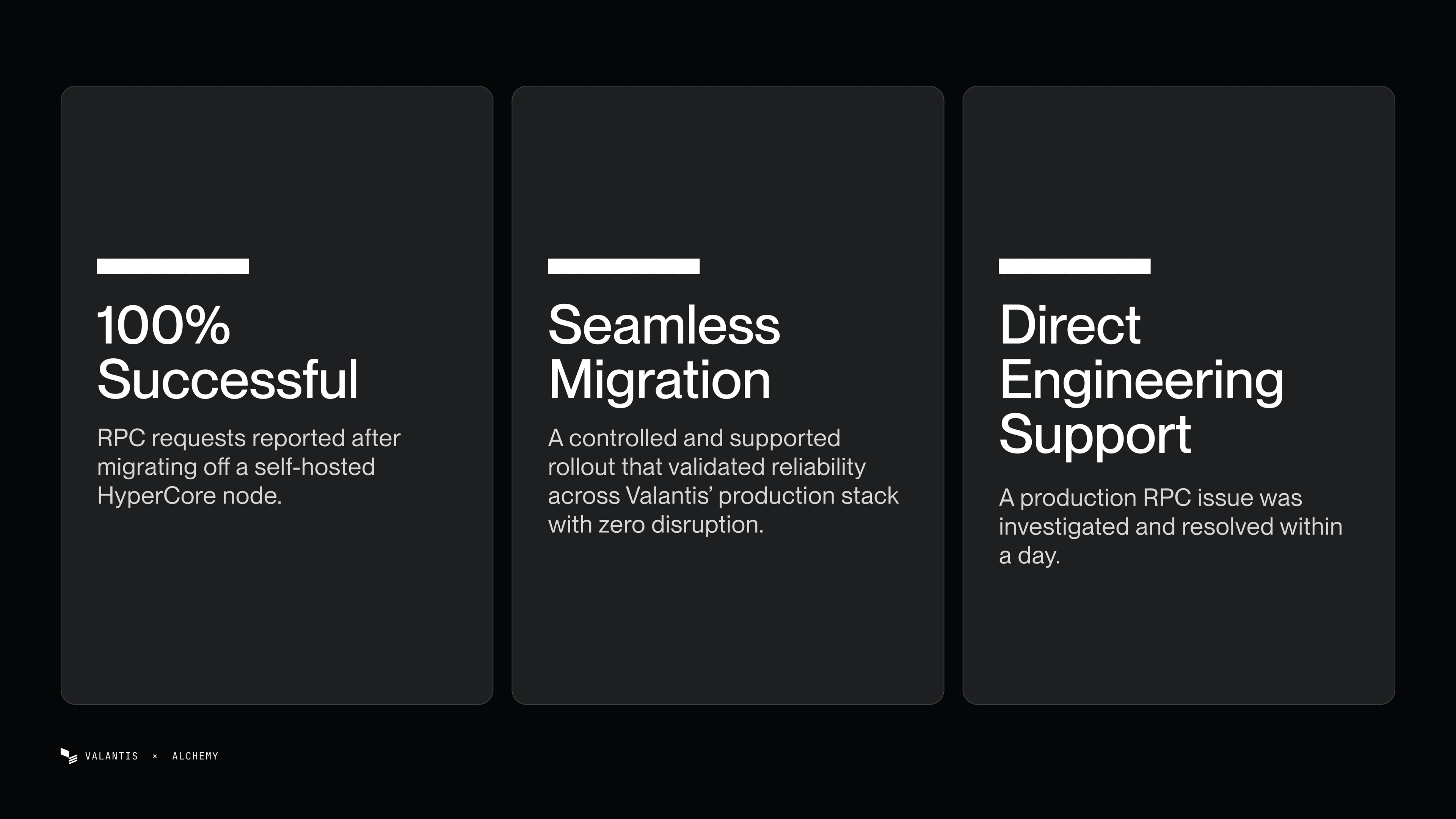
After moving HyperEVM RPC calls from a self-hosted node to Alchemy’s HyperEVM Node, service by service, Valantis reports 100% successful RPC requests. The team now has a more dependable foundation for DCA access, keepers, and product data, plus a direct engineering support path when an issue needs attention.
Products used: Alchemy HyperEVM Node
The challenge: self-hosted node downtime created customer and operations risk
Valantis had been self-hosting HyperEVM RPC on a node that went down intermittently multiple times per week. When a peer went down, the node could go down with it. Hyperliquid network upgrades added another source of disruption. Depending on the upgrade, the RPC could be unavailable overnight for hours.
The problem extended beyond the outage itself. Valantis’ alarms could not always distinguish a logic error from an unavailable RPC. Incidents were harder to diagnose, and the team carried recurring operational work.
Retries could reduce the immediate impact of an RPC failure. They could not fix the unreliable dependency underneath. Valantis needed a node layer that let product services operate consistently, with a clear escalation path when something did go wrong.
The solution: a controlled migration to Alchemy’s HyperEVM Node
Migrate deliberately, validate service by service
Valantis chose Alchemy for a familiar, standards-aligned Ethereum node experience and the confidence that responsive engineering support would be available when needed.
Rather than move everything at once, the team migrated backend services individually to the Alchemy node. That gave Valantis a controlled way to validate stability service by service and understand usage across its product stack before completing the transition.
Keep the integration simple, and support close
The migration did not require a documentation-heavy integration. Because Alchemy conforms to standard Ethereum node specifications, Valantis could move its existing services without introducing a new operating model.
That partnership was tested during the migration. When Valantis identified an RPC issue, Alchemy’s engineering team worked directly with them to investigate and resolve it within a day. The result was more than a dependable node endpoint: Valantis gained an infrastructure partner built to deliver reliable uptime, responsive performance, and hands-on support when production issues matter most.
"We need our infrastructure to just work so we can stay focused on building a great trading experience. Alchemy has given us a more reliable foundation and a team that is quick to help when we need it."
— Deven Matthews, CEO, Valantis
The results: a more dependable foundation for trading workflows
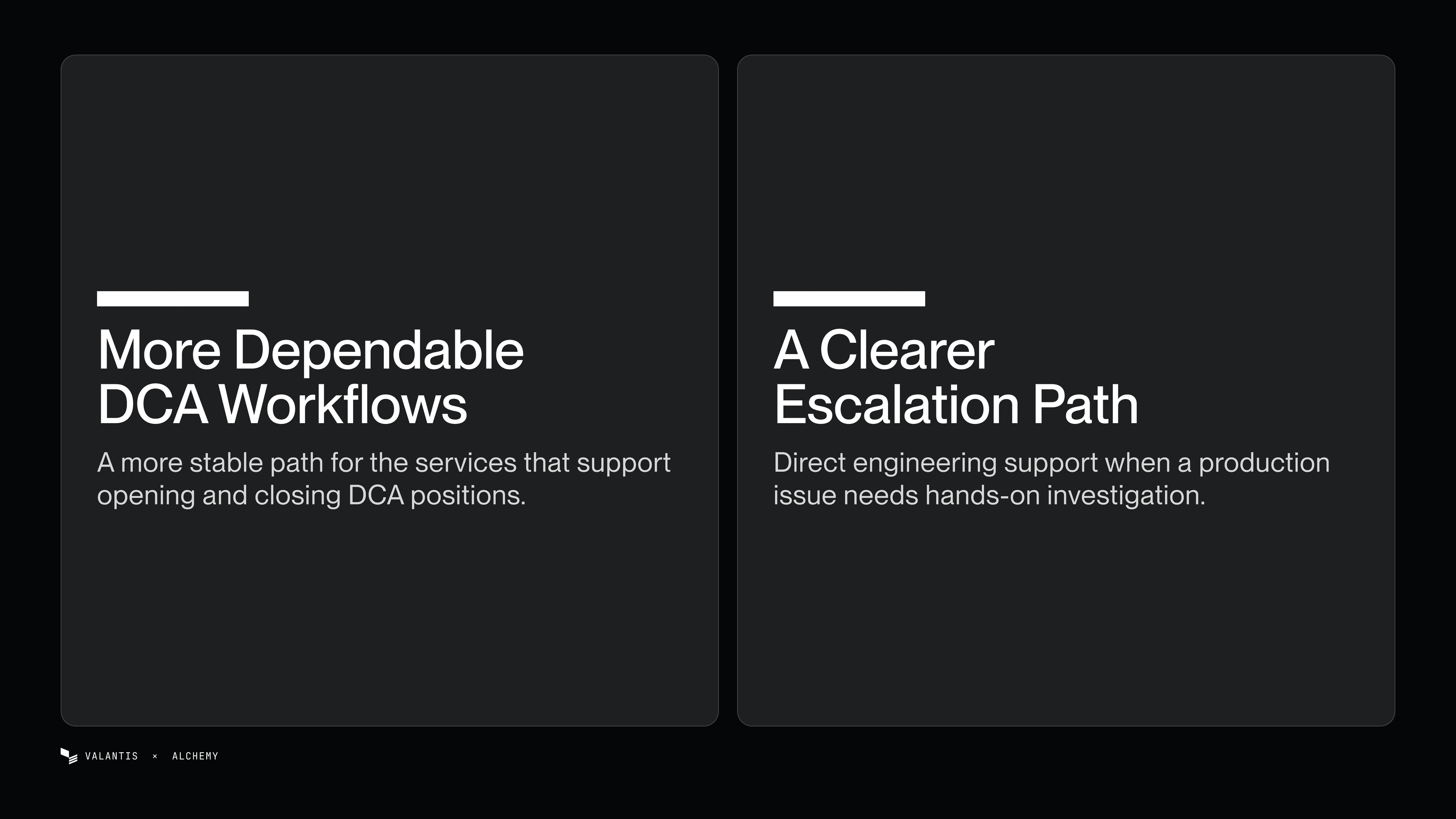
For DCA users, a backend interruption can mean being unable to open or close a position. After the migration, RPC failures are no longer blocking traders from opening or closing DCA positions, giving the services behind those actions a more stable node foundation.
Its keeper services and data indexing are also part of the product experience, not invisible background systems. A dependable node layer helps Valantis keep those services running and its website data current when users are making decisions.
With a more reliable RPC layer and a direct engineering support path, the team has a clearer route to diagnose and escalate infrastructure issues. Less time is spent second-guessing whether an error originated in its own logic or an unavailable node.
Build Hyperliquid products on infrastructure that stays out of the way
For Earn and Trading products, reliability is part of the user experience. Alchemy gives teams building on Hyperliquid a dependable node layer and engineering support so they can focus on the products their users come to use.
Related case studies
 DeFi
DeFiOctober 13, 2026
How Cash App makes stablecoin money movement feel as simple as cash
Cash App uses Alchemy Node APIs and Webhooks so every stablecoin balance and transfer stays continuously verifiable against public chain state.
 DeFi
DeFiSeptember 15, 2026
How AllScale powers fast, reliable stablecoin payments at scale
AllScale standardized blockchain reads and transaction requests on Alchemy Node API to power stablecoin checkout, invoicing, payroll, and payouts.
 DeFi
DeFiAugust 25, 2026
How Struct is building the data layer for onchain finance with Alchemy
Struct uses Alchemy node APIs and WebSockets to power the data layer for onchain finance, with one partner for its expanding multi-chain footprint.

Build blockchain magic
Alchemy combines the most powerful web3 developer products and tools with resources, community and legendary support.