Best Hyperliquid RPC providers in 2026: HyperEVM and HyperCore compared

Written by Uttam Singh
The best Hyperliquid RPC provider for your project depends on which part of the chain you build on. Hyperliquid runs two environments on one chain. HyperEVM runs Solidity smart contracts over standard Ethereum JSON-RPC. HyperCore is the native trading engine, and its order books, fills, and funding data come through a separate API and streams. Choosing a Hyperliquid provider starts with which layer you need.
This guide compares ten Hyperliquid providers (Alchemy, QuickNode, Chainstack, Dwellir, HypeRPC (now Hyperdash), GoldRush, Hydromancer, Allium, dRPC, and OnFinality) on HyperEVM RPC, HyperCore data, and node peering. For most teams, we recommend Alchemy, which covers HyperEVM RPC and HyperCore streaming on one API key, and the end of the guide explains why.
What is the difference between HyperEVM and HyperCore?
HyperCore is Hyperliquid's native trading engine. Perpetual and spot order books, orders, fills, and liquidations live directly in chain state, and the Hyperliquid docs put its throughput at roughly 200,000 orders per second. HyperCore doesn't run smart contracts and doesn't speak Ethereum JSON-RPC. Apps read it through Hyperliquid's info API and WebSocket subscriptions, or through a provider's own streams.
HyperEVM is the EVM-compatible environment where Solidity contracts run, with HYPE as the gas token and chain ID 999. Both environments share state and are secured by HyperBFT, Hyperliquid's consensus mechanism. A HyperEVM contract can read HyperCore state such as positions, balances, and oracle prices through precompiles, and send actions to HyperCore through a system contract called CoreWriter. If you're deciding whether to build on HyperEVM at all, our post Is HyperEVM dead? No, and here's the data walks through the usage numbers.
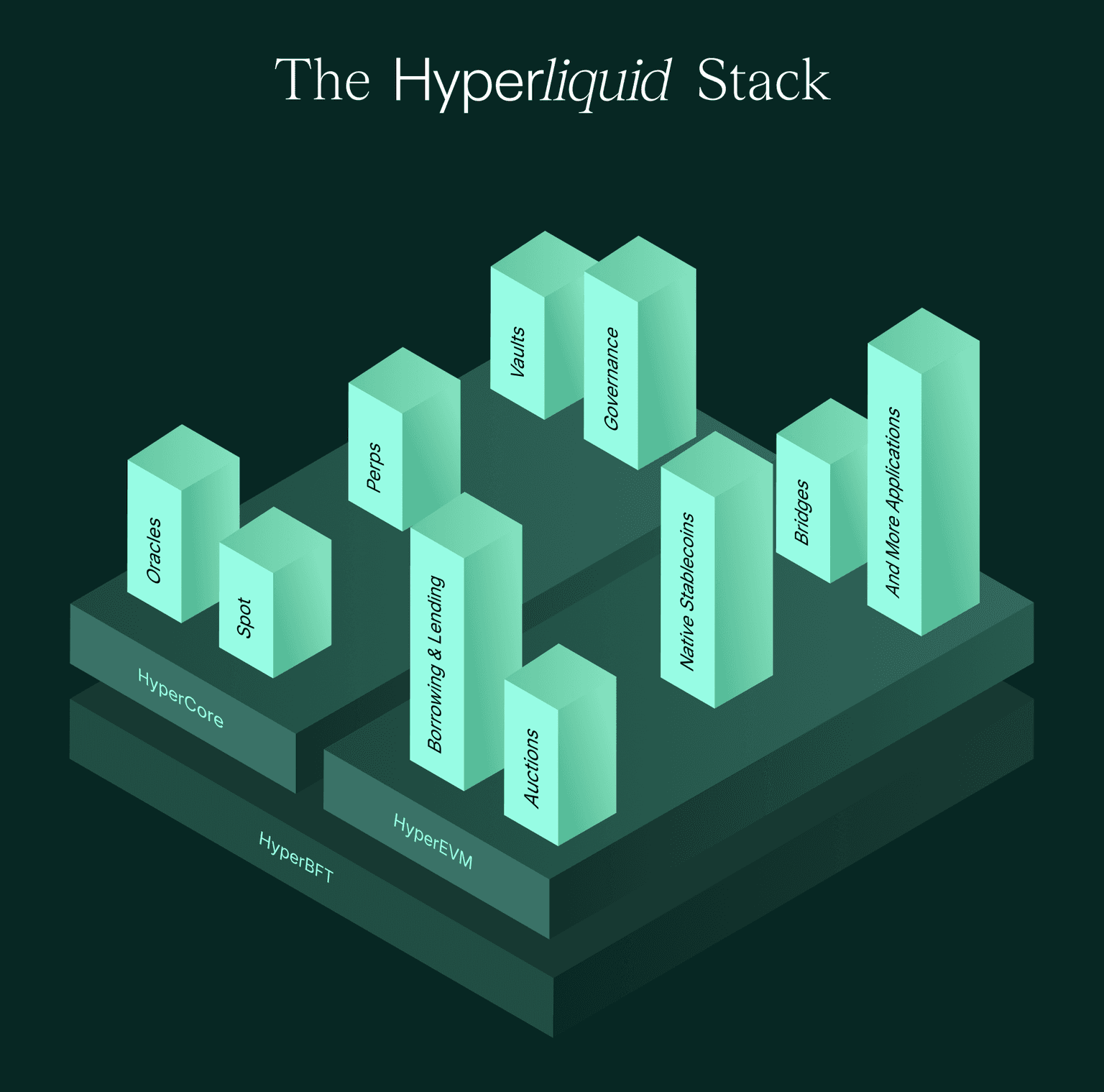
The split decides what you buy. A HyperEVM RPC endpoint gives you eth_ methods, so ethers, viem, Foundry, and Hardhat work unchanged. HyperCore data needs a different interface: the info API for point-in-time reads, and WebSocket or gRPC streams for order books and fills as they change. If you deploy contracts, you need a HyperEVM RPC. If you trade, quote, liquidate, or show live markets, you need HyperCore data. Many teams need both.
How did we compare Hyperliquid providers?
We're one of the providers in this list, so we've stuck to what each provider documents in its own public docs. We compared them on three things:
- HyperEVM RPC. Mainnet and testnet coverage, WebSocket support, archive data, and debug and trace methods.
- HyperCore data. Whether the provider serves the info API, streams order books and fills, and offers incremental (L2 diff) or order-level (L4) books, and over which transport.
- Node peering. Whether teams running their own Hyperliquid node can peer with the provider's node.
We left out latency and uptime rankings. We haven't found an independent benchmark that compares Hyperliquid providers on the same terms, and each provider measures its own numbers differently.
How do the best Hyperliquid RPC providers compare?
Every cell comes from the provider's own public docs, checked in October 2026. "Not documented" means we couldn't find it in public docs, not that the provider can't offer it on request.
Which Hyperliquid RPC providers cover both HyperEVM and HyperCore?
Alchemy
We serve HyperEVM RPC on mainnet and testnet, over HTTPS and WebSocket, on the same account and API key as the 100+ networks we support. On mainnet that key also covers the Debug API, eth_subscribe, eth_simulateV1, webhooks, the Token API, the Transfers API, and gas sponsorship. HyperEVM is also served from our Tokyo region, so teams running their stack in Tokyo near Hyperliquid stay in-region. Requests route there automatically, with no new endpoint. The Hyperliquid testnet faucet hands out testnet HYPE for contract testing.
HyperCore streaming is in early access. It streams L2 order books and incremental book updates, order-level (L4) updates that carry each order's queue position, best bid and offer (BBO), and fills. You connect over the HyperCore WebSocket API, which follows Hyperliquid's subscription format with a few changes, so most clients port over with small edits. It's served from Hyperliquid nodes we operate in Tokyo, and it runs on the API key you already use for HyperEVM. Because HyperEVM RPC is also served from our Tokyo region, both layers of a trading stack running in Tokyo stay in-region. If you're joining those streams in your own system, our guide to Hyperliquid orders vs trades vs fills covers the payloads and how to reconcile them.
For teams running their own node, we offer HyperCore node peering, with a seven-business-day evaluation on request. The Hyperliquid Foundation lists us among its peers for builders.
We're the right fit when you want HyperEVM and HyperCore on the same account as the rest of your multi-chain stack. Our post on going all-in on Hyperliquid covers why we're building across both layers.
QuickNode
QuickNode's Hyperliquid docs describe HyperEVM and HyperCore on one endpoint. HyperEVM comes in two paths. The /evm path is HTTP only and serves recent blocks, with older data pruned about every 12 hours. The /nanoreth path adds WebSocket, full archive data, and debug and trace methods.
On HyperCore, QuickNode serves the info and exchange APIs, a HyperCore WebSocket, and a gRPC service whose streams include L2 and L4 books, book diffs, and BBO. HyperCore support launched in public beta in January 2026.
Chainstack
Chainstack's Hyperliquid reference covers HyperEVM mainnet and testnet in full and archive modes, with debug and trace methods on archive nodes. Like QuickNode, it exposes both an /evm path and a /nanoreth path, which differ in whether system transactions are included.
For HyperCore, Chainstack serves 46 info API methods from its own nodes and passes the rest through to Hyperliquid's public API. Trading actions go through the public exchange API. Order book and fill subscriptions go through Hyperliquid's public WebSocket API. We didn't find gRPC or L4 order book streams in its public docs.
Dwellir
Dwellir sells HyperCore data as separate products on top of its HyperEVM RPC. Dwellir's HyperCore gRPC service offers 14 typed streams, including L2 and L4 books, BBO, and several kinds of fills. Its order book WebSocket serves L2 books up to 100 levels per side, L4, BBO, and trades from servers in Singapore and Tokyo. It also publishes historical HyperCore data as downloadable files.
HyperEVM RPC covers mainnet over HTTPS and WebSocket, with debug and trace enabled. We didn't find HyperEVM testnet in its public docs.
HypeRPC (now Hyperdash)
HypeRPC, now part of Hyperdash, is a Hyperliquid-only provider. Every endpoint supports HTTPS and WebSocket. Its Reth-based archive nodes serve historical state and trace calls.
On HyperCore, HypeRPC offers a private replacement for the official info API, an order book WebSocket with L2 and L4 data up to 100 levels, and raw data streams that it's onboarding in waves. You choose between regions in Tokyo and the EU. Direct sentry peering is available, but access is gated.
GoldRush
GoldRush, from Covalent, serves HyperEVM RPC with archive depth and debug and trace methods. On HyperCore it offers a drop-in info API, WebSocket streams for L2 books, L2 diffs, L4 books, and fills, and a GraphQL streaming API, served from dedicated Hyperliquid nodes in Tokyo.
Which providers focus on HyperCore data only?
Hydromancer
Hydromancer is a HyperCore data provider and doesn't offer HyperEVM RPC. It serves an info-compatible API, streams BBO, L2 books, L2 diffs, L4 updates, fills, trades, and builder-code activity over WebSocket, and publishes historical data exports. Its peering runs in AWS Tokyo, with a seven-day trial.
Allium
Allium's Hyperliquid API offers drop-in replacements for Hyperliquid's info endpoints, plus fills, order history, funding, and L4 order book snapshots. It also exposes Hyperliquid history through SQL and delivers data streams over WebSocket, Kafka, and Pub/Sub. Allium doesn't offer HyperEVM RPC. Its sentry peer runs in Tokyo.
Which providers offer HyperEVM RPC only?
dRPC
dRPC's Hyperliquid endpoints serve HyperEVM mainnet and testnet over HTTPS and WebSocket, with archive data. dRPC routes requests across a network of independent node operators. It doesn't document HyperCore data.
OnFinality
OnFinality's Hyperliquid endpoints serve HyperEVM over HTTPS and WebSocket with archive data, plus HyperCore info API methods such as l2Book, userFills, and candleSnapshot. It doesn't document HyperCore streams. Dedicated nodes are available.
What is Hyperliquid node peering?
Some teams run their own Hyperliquid node (hl-node) instead of relying on a provider's API, usually to read data the public API doesn't expose. A non-validating node has to connect to peers to receive blocks. Public peer slots are limited and get congested when demand peaks, so a node with poor peers falls behind.
Peering gives your node a dedicated connection to a provider's node. The Hyperliquid Foundation keeps a list of infrastructure providers that have committed to offer peering to the public, with no preferential treatment for specific clients. We're on it, along with Allium, Dwellir, Hydromancer, and QuickNode.
Which Hyperliquid provider should you choose?
For most teams building on Hyperliquid, we recommend Alchemy. The reasons are concrete:
- Both layers on one API key. HyperEVM RPC and HyperCore streaming run on the same account and key, next to the 100+ networks we support, so you don't stitch together separate vendors for one chain.
- A full HyperEVM toolkit, served from Tokyo. HyperEVM requests route to the closest region automatically, including Tokyo for teams running their stack there. Mainnet comes with WebSocket subscriptions, the Debug API, webhooks, the Token API, the Transfers API, and gas sponsorship, and testnet has its own endpoint and faucet.
- The HyperCore data trading systems need. L2 books and incremental updates, L4 order-level updates, BBO, and fills over WebSocket, served from Hyperliquid nodes we operate in Tokyo.
- Peering for self-hosted nodes. If you run your own node, you can peer with ours, and the Hyperliquid Foundation lists us among its peers.
The table below maps common builds to a starting point.
How do you get started with Hyperliquid on Alchemy?
Create an Alchemy account and copy your Hyperliquid RPC endpoint from the dashboard. Because HyperEVM uses standard JSON-RPC, moving from another provider is usually a matter of swapping the endpoint URL.
When you need HyperCore order books, BBO, and fills, request early access to HyperCore streaming. It runs on the same API key as your HyperEVM endpoint. If you run your own node, request HyperCore node peering and start with the seven-business-day evaluation.
FAQ
What is the best Hyperliquid RPC provider?
For most teams, we recommend Alchemy. It serves HyperEVM RPC with WebSocket, the Debug API, and webhooks, and HyperCore streaming of order books, BBO, and fills in early access, all on one API key. Teams running their own node can also peer with Alchemy's Hyperliquid node.
Does Alchemy support HyperCore?
Yes. Alchemy serves HyperEVM RPC and HyperCore data. HyperCore streaming is in early access and covers L2 order books, incremental book updates, L4 order-level updates, best bid and offer, and fills over WebSocket, on the same API key as HyperEVM. Alchemy also offers HyperCore node peering for teams running their own node.
Which Hyperliquid providers offer WebSocket streaming?
For HyperEVM, Alchemy, QuickNode, Chainstack, Dwellir, HypeRPC (now Hyperdash), dRPC, and OnFinality support WebSocket subscriptions. For HyperCore market data, Alchemy, QuickNode, Dwellir, HypeRPC, GoldRush, and Hydromancer stream order books over WebSocket. QuickNode and Dwellir also offer gRPC. The public Hyperliquid API streams L2 snapshots but not incremental or L4 updates.
What infrastructure does a Hyperliquid trading bot need?
A Hyperliquid trading bot needs live HyperCore market data (order books, best bid and offer, and fills for its own accounts) plus a way to submit orders through Hyperliquid's exchange API. Public WebSocket limits cap connections, subscriptions, and tracked users, so production bots typically use a provider's HyperCore streams or run their own node with peering.
Where can I get historical Hyperliquid funding and candle data?
Hyperliquid's public info API returns funding history through the fundingHistory request and candles through candleSnapshot, subject to public rate limits. For deeper history, Allium exposes HyperCore data through SQL, Hydromancer publishes historical exports, and Dwellir offers downloadable historical files.
What is the difference between a HyperEVM RPC and a HyperCore API?
A HyperEVM RPC uses standard Ethereum JSON-RPC methods, so it works with ethers, viem, Foundry, and Hardhat for smart contracts. A HyperCore API serves data from Hyperliquid's native trading engine, such as order books, orders, fills, positions, and funding, through the info API and WebSocket or gRPC streams. Many teams use both.
Related Overviews
 Technical
October 20, 2026
Hyperliquid orders vs trades vs fills
On Hyperliquid, orders, trades, and fills are three different records. Here's each HyperCore payload, how they join on oid and tid, and how to reconcile them.
 Technical
October 29, 2026
What is a webhook?
A webhook is an event notification delivered as an HTTP POST. Learn how webhook URLs, payloads, retries, and signature verification work, with onchain examples.
 Wallets
October 19, 2026
What is account abstraction? ERC-4337 explained
Account abstraction lets a smart contract act as your account. ERC-4337 delivers it without changing Ethereum, and EIP-7702 brings it to existing EOAs.

Build blockchain magic
Alchemy combines the most powerful web3 developer products and tools with resources, community and legendary support.